

Last reviewed: September 2026
The short version
Almost every claim you will read about a peptide is technically true and describing something that happened somewhere other than a human being.
That is not an accusation of dishonesty. It is a description of where this field actually is. Most peptide research consists of cell culture work and rodent studies, and a great deal of it is genuinely interesting. What gets lost between the laboratory and the landing page is the one detail that changes what the finding means: who or what it happened to.
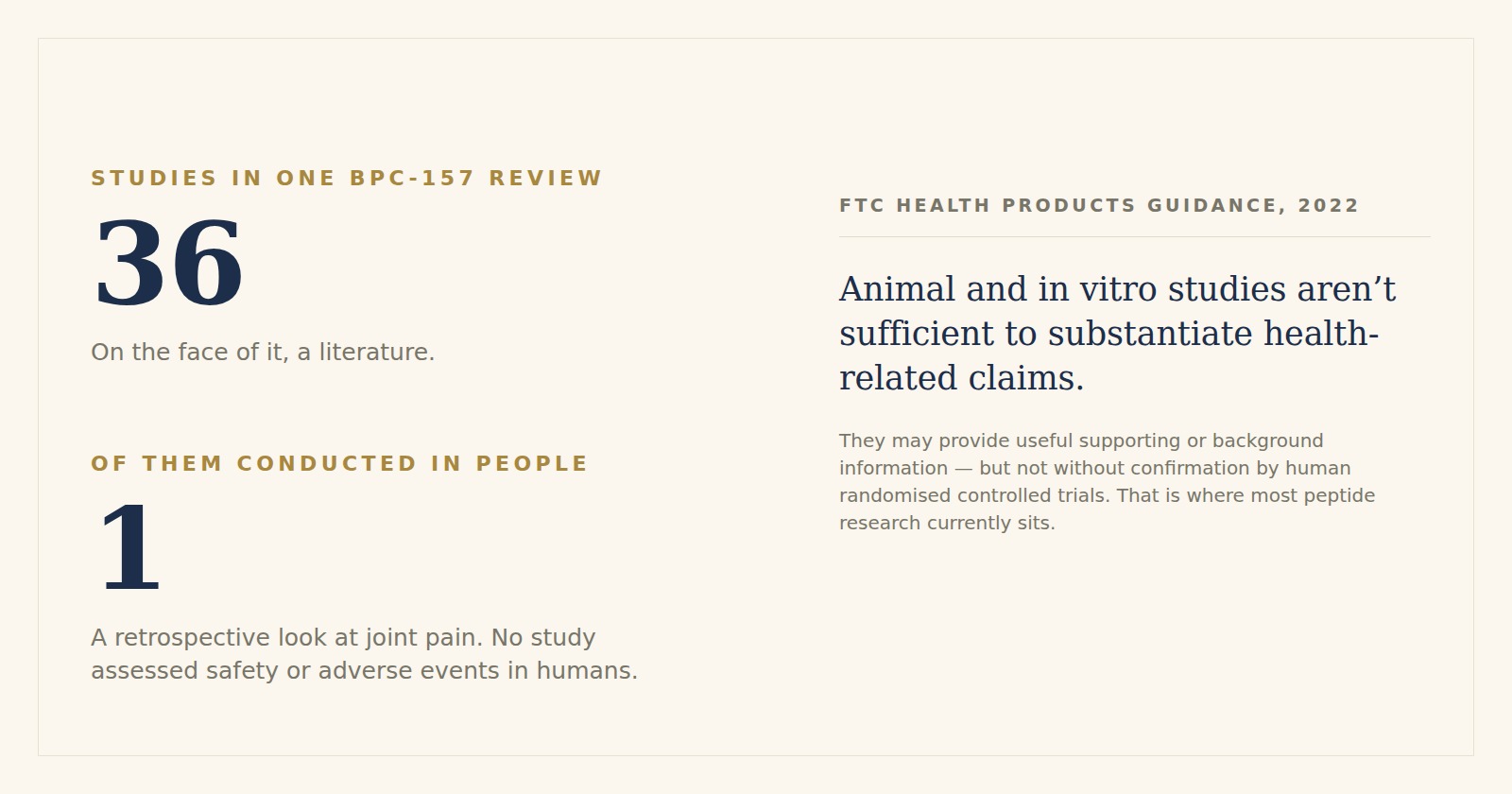
The Federal Trade Commission draws this line explicitly, and it is a useful line for a reader to borrow. In its Health Products Compliance Guidance it says that animal and in vitro studies “may provide useful supporting or background information, but, without confirmation by human RCTs, they aren’t sufficient to substantiate health-related claims.”
This piece is about how to tell which side of that line something is on. It is deliberately not about whether any particular peptide works.
Why animal results so often do not carry over
The instinct is that a strong rodent result is most of the way to a human one. The record says otherwise.
A review of animal studies published in seven high-impact journals found that about one-third of them went on to be tested at the level of human randomised trials, and about one-tenth of the interventions were eventually approved for use in patients.
That attrition continues even after human testing begins. Across more than 400,000 clinical trial records covering some 21,000 compounds, the estimated probability that a compound entering phase 1 eventually reaches approval is around 14%.
Read those two numbers together and the picture is clear enough. A promising animal finding is not a small step away from a treatment. It is the beginning of a process that most candidates do not survive — usually because the effect turns out to be smaller in people, or absent, or accompanied by something unacceptable.
None of which makes animal work useless. Every drug you have ever taken passed through it. The error is treating the first rung as though it were the last.
A worked example: thirty-six studies, one of them human
BPC-157 is one of the most discussed peptides on the internet, so it makes a useful case.
A 2025 systematic review looked at its use in orthopaedic sports medicine and identified 36 studies. On the face of it that is a literature.
Of those 36, 35 were preclinical. One was a human study — a retrospective look at musculoskeletal pain after injection into a joint. The reviewers found a single registered phase 1 trial, of unknown status since 2016. And they recorded, in as many words, that no study had assessed safety or adverse events in humans.
Their conclusion was that clinical safety in humans remains unknown and that caution is warranted given the lack of high-quality clinical data.
Nothing about that summary says BPC-157 does not work. It says something narrower and more useful: as of that review, the human evidence to judge it by did not exist. “Thirty-six studies” and “one human study” are both accurate descriptions of the same literature, and only one of them tells you what you need.
A second example, from our own materials
This one is closer to home, and it is here because it is the clearest illustration of the pattern.
Our peptide reference notes that a widely cited review reports GHK-Cu up- and downregulating at least 4,000 human genes. It is a genuinely striking number and it is repeated everywhere.
The same page of our reference then says where it comes from: gene-expression analyses of cultured human cell lines, not studies in living people.
That is the right way to report it, and it is worth pausing on why the disclosure matters. Gene-expression work in cell culture produces the most impressive-sounding numbers in all of biology, because a dish full of cells will respond to a compound in ways an intact person will not — no liver, no bloodstream, no dose that has to survive being absorbed and distributed. A large number from a dish is not evidence of a large effect in a body. It is evidence that the cells noticed.
If you take one habit from this article, take that one: whenever a number is very large, ask what it was measured in.
Six questions that do most of the work
You do not need to read the papers. You need to ask what the papers were.
- What species? This single question resolves more claims than the other five combined.
- How many participants? Twelve people is a signal. Twelve hundred is evidence. Both get called a study.
- Was there a control group, and was assignment random? Without a comparison, improvement over time cannot be separated from the treatment, and people in trials get better for many reasons.
- Same route, same duration? A compound injected into a rat’s abdomen for a week is a different question from the same compound taken by mouth for a year.
- Was the endpoint an outcome or a marker? A blood value moving is not the same as a person functioning better. Sometimes markers predict outcomes. Often they do not.
- Where was it published, and who paid? Peer review is an imperfect filter, and it is still a filter. Conference abstracts and preprints have not passed it.
Two things worth knowing about how research reaches you
Preprints are not peer reviewed. They are drafts posted publicly before assessment. Many are excellent and later published unchanged. The point is only that a preprint has not yet been checked by anyone other than its authors, and it is often cited as though it had been.
Publication bias runs one way. Studies finding an effect are more likely to be written up, submitted and accepted than studies finding nothing. So the published literature on any compound is systematically more encouraging than the research that was actually done. This applies to everything, not only to peptides — it is simply more consequential in a field where the total volume of human evidence is small enough that a few positive papers can look like a consensus.
What this does not mean
It would be easy to read all of the above as an argument that peptides are nonsense. That is not the argument, and it would be its own kind of sloppiness.
Early evidence is not the same as no evidence. A compound with promising preclinical work and a plausible mechanism is a reasonable thing to be interested in. Some peptides are FDA-approved medicines with substantial trial data behind them, and the word covers an enormous range — insulin is a peptide.
The distinction that matters is between a clinician who says “the human evidence here is limited, this is what we do and do not know, and here is how we would monitor you” and a website that says “clinically proven.” Both may be offering the same molecule. Only one of them has told you where you are standing.
The regulatory picture is a separate question from the evidence picture, and it moves faster — that is covered in the piece on where peptide regulation actually stands. Where a preparation is made and by whom is a third question again, and it is dealt with in what compounded actually means.
What to ask us, or anyone else
The questions in Figure 2 are not rhetorical. They are the ones worth putting to any practice, including this one.
- What tier of evidence supports this specific use, in humans?
- What are you monitoring, how often, and what result would make you stop?
- What is the plan if it does not work — and what would “not working” look like?
- Is this an FDA-approved product, and if not, what does that mean for me?
- What would you say to a patient who asked whether this is worth the money?
The same reasoning is why a careful practice requires labs before treatment: if you cannot measure anything, you cannot tell whether something is working, and every judgement afterwards is a guess dressed up as a plan.
Where I land
The most useful skill in this area is not knowing which peptides work. It is being able to tell, in about thirty seconds, whether the person telling you a peptide works has human evidence, animal evidence, or a sentence they read somewhere.
That skill costs nothing, it does not expire, and it applies well beyond peptides. Almost every overstated health claim you will encounter has the same structure: a real finding, from a real study, described in a way that quietly upgrades what it was.
Frequently asked questions
Is peptide research real science?
Much of it is, and most of it is early. The bulk of published peptide research consists of cell culture work and animal studies, which are legitimate stages of research but are not sufficient on their own to support a claim about what a compound will do in a person. The Federal Trade Commission states that animal and in vitro studies may provide useful supporting or background information but, without confirmation by human randomised controlled trials, they are not sufficient to substantiate health-related claims.
What does “clinically proven” actually mean?
On a product page, frequently nothing. The phrase has no regulatory definition and is used to describe everything from a large randomised trial to a survey of people who liked the product. The question that settles it is whether there was a control group and whether participants were randomly assigned to it — without both, improvement over time cannot be separated from the treatment.
Why do so many animal studies fail to translate to humans?
Because animals are not small people. A review of animal studies in high-impact journals found that about one-third were subsequently tested in human randomised trials and about one-tenth of the interventions were eventually approved for patients. Attrition continues after human testing starts: across more than 400,000 trial records covering around 21,000 compounds, the estimated probability that a compound entering phase 1 reaches approval is roughly 14%.
How much human evidence is there for BPC-157?
As of a 2025 systematic review of its use in orthopaedic sports medicine, very little. That review identified 36 studies, of which 35 were preclinical. The single human study was a retrospective look at musculoskeletal pain after injection into a joint, and the reviewers recorded that no study had assessed safety or adverse events in humans. Their conclusion was that clinical safety in humans remains unknown.
What does it mean when a peptide is said to regulate thousands of genes?
Usually that gene expression was profiled in cultured cells rather than in people. Cell culture produces the largest and most impressive numbers in biology, because a dish of cells responds to a compound without a liver, a bloodstream or the problem of absorption. A large number measured in a dish is evidence that the cells responded, not that a person would.
What should I ask a clinic before starting a peptide?
What tier of evidence supports this specific use in humans; what will be monitored, how often, and what result would stop treatment; what the plan is if it does not work and what “not working” would look like; whether it is an FDA-approved product and what it means if it is not; and what they would say to someone asking whether it is worth the money. A clinician who answers those without hesitating is telling you something. So is one who cannot.
Before you go
If a claim impresses you, the useful next thought is not whether it is true but what it was measured in. That question is free to ask and it will change what you believe about half of what you read.
This article is for general education and is not medical advice for any individual. It doesn't establish a physician-patient relationship. Talk to a licensed clinician about your own situation.