

Last reviewed: August 2026. Regulation in this area is actively in motion, and parts of this page have a short shelf life. If the date above is not recent, check the FDA's current materials before relying on anything here.
I get some version of this question almost every week: are peptides legal?
It sounds like a yes-or-no question. It isn't. And in 2026 it has gotten considerably more confusing, because two things happened this year — one in April, one in July — that were widely reported as "the FDA approved peptides." Neither of them was that. Not close.
So I want to lay out where things actually stand. I'm not going to tell you on this page that any particular peptide will do anything for you, because I can't tell you that honestly and neither can anyone else. What I can do is explain the machinery, accurately, and show you where it's still unresolved — because the unresolved parts are the whole story.
The short version
As of this writing in August 2026:
- No peptide in the "wellness peptide" category — BPC-157, TB-500, KPV, MOTS-c, Semax, Epitalon, and the rest — is an FDA-approved drug. None of them.
- In April 2026, the FDA removed twelve peptides from a list called Category 2. That happened because the people who had nominated those substances withdrew their nominations — not because the FDA reviewed them and found them safe.
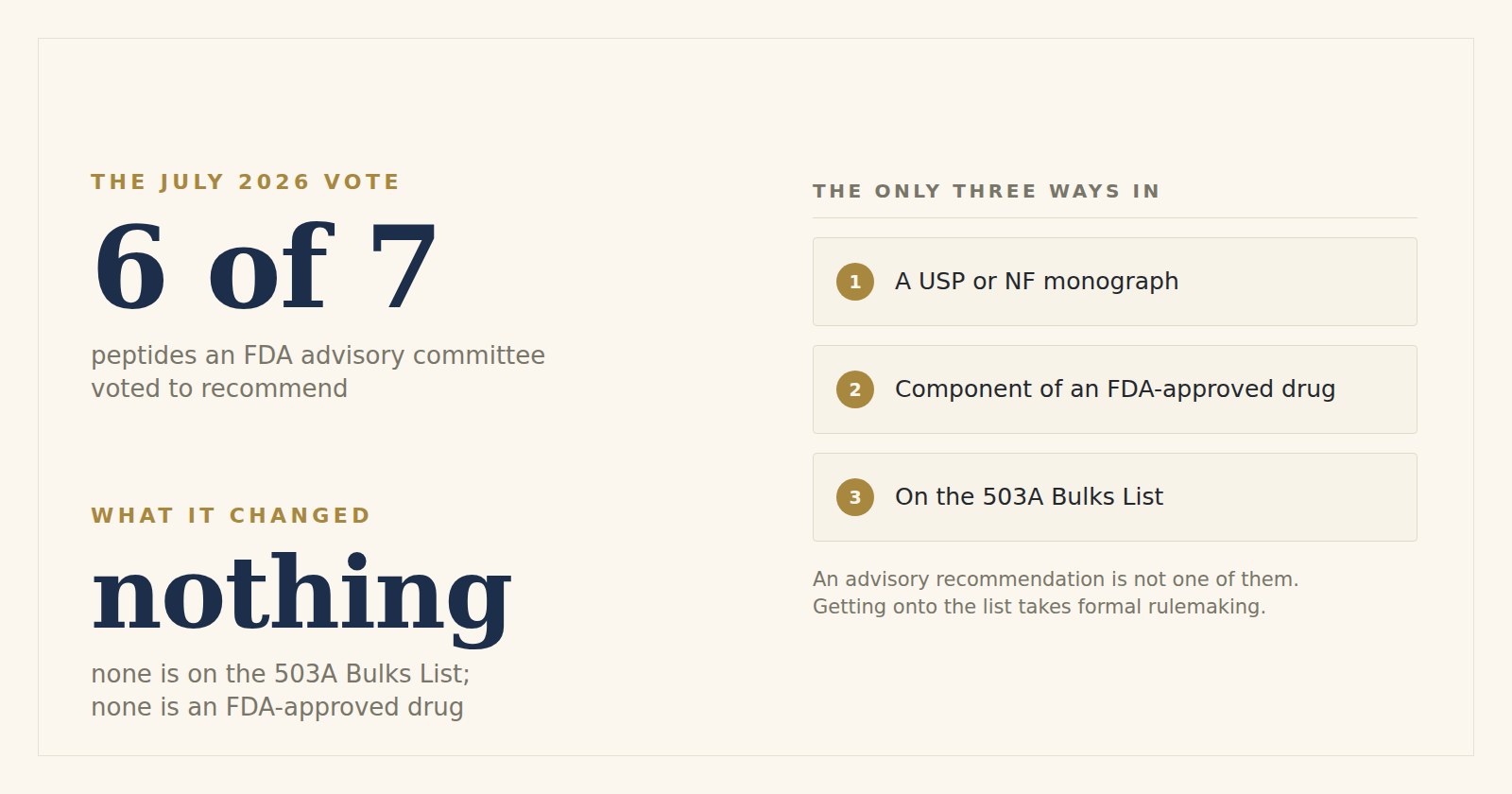
- In July 2026, an FDA advisory committee voted narrowly to recommend six peptides for a list that would allow certain pharmacies to compound them. The FDA's own scientists had recommended against all seven substances under review. The committee's vote is advisory. It changes nothing on its own.
- As of today, the FDA has not acted on that recommendation, and the substances are not on the list. Getting there requires formal notice-and-comment rulemaking, which takes many months.
If you read a headline this year that said peptides were legalized, approved, or cleared — that headline was wrong. Here's why, step by step.
Why peptides sit in such a strange legal space
A peptide is just a short chain of amino acids. That's a chemistry description, not a legal category, which is the root of the confusion. Some peptides are FDA-approved prescription drugs that have been through full clinical trials — insulin is a peptide. Semaglutide is a peptide. Others are sold on the internet in vials labeled "for research use only." The word "peptide" tells you nothing about which situation you're in.
Under U.S. law, a substance intended to diagnose, treat, or prevent disease is a drug, and drugs generally require FDA approval before they can be marketed. Almost none of the peptides people ask me about have that approval. So the only lawful route that gets discussed for them is compounding — and compounding is a narrow exception with its own rulebook, not a general-purpose workaround.
Compounding 101: what 503A and 503B actually mean
Compounding is when a licensed pharmacist or physician combines or alters ingredients to make a medication for a particular patient's need. Two sections of the federal Food, Drug, and Cosmetic Act govern it, and the difference between them matters more than most patients realize.
Section 503A — traditional compounding pharmacies. These are state-licensed pharmacies and physicians compounding for an identified individual patient, generally in response to a prescription. Day-to-day oversight sits mostly with state boards of pharmacy; the FDA does surveillance inspections. Notably, 503A compounders are not subject to current good manufacturing practice (CGMP) requirements.
Section 503B — outsourcing facilities. These register with the FDA, are primarily overseen by the FDA, are inspected on a risk-based schedule, and are subject to CGMP requirements. They can produce larger batches, including without a patient-specific prescription, and typically supply clinics and hospitals.
Here is the sentence I want you to take away, in the FDA's own words: "Compounded drugs are not FDA-approved. This means that FDA does not verify the safety, effectiveness or quality of compounded drugs before they are marketed."
That is true of every compounded preparation, from a simple pediatric suspension to anything else. It is not a scare tactic; it's the actual regulatory status, and any clinic that isn't telling you that plainly is doing you a disservice.
The three doors: how a raw ingredient becomes eligible for 503A compounding
This is the part that unlocks the rest. To compound with a bulk drug substance — the raw active ingredient, as opposed to a finished FDA-approved drug — under section 503A, the substance has to satisfy one of exactly three conditions:
- It complies with an applicable USP or NF monograph, if one exists; or
- It is a component of an FDA-approved drug product; or
- It appears on the 503A Bulks List — a list the FDA builds through formal notice-and-comment rulemaking, codified in federal regulation.
That's the whole universe. Three doors. Most of the peptides in circulation don't have a USP or NF monograph and aren't components of an approved drug, which leaves door number three — and the 503A Bulks List is small. A February 2019 final rule placed six substances on it. It has grown slowly since, through rulemaking, one batch at a time.
Category 1, Category 2, Category 3 — the interim lists everyone argues about
Because building that list by rulemaking is slow, the FDA created an interim policy for substances that have been nominated for the list but not yet evaluated. Nominated substances get sorted into three buckets:
- Category 1 — nominated with enough supporting information for the FDA to evaluate, and not otherwise disqualified. The FDA says it does not intend to take enforcement action against compounders using these substances while evaluation is pending, provided certain conditions are met. This is enforcement discretion, not approval. It can change.
- Category 2 — substances that may present significant safety risks in compounding. The FDA publishes its safety concerns and says it would consider enforcement action against compounders using them.
- Category 3 — nominated without enough information for the FDA to evaluate. No Category 1 protection; enforcement action remains possible.
Three points people constantly miss. First, none of these categories is approval — Category 1 is the FDA declining to act right now, which is a different thing entirely. Second, being on no list is not permission; the three doors above are still the test. Third, the FDA has said it does not intend to place substances nominated on or after January 7, 2025 into these categories at all, which means the interim scheme is winding down rather than expanding.
Among peptide-adjacent substances, the FDA's list as updated in May 2026 places glutathione, NAD, NADH, L-theanine, and GHK-Cu (except for injectable routes of administration) in Category 1.
What actually happened in April 2026
On April 15, 2026, the FDA announced it was removing twelve peptides from Category 2, effective within seven calendar days. The twelve were BPC-157; Cathelicidin LL-37; Dihexa acetate; Emideltide (DSIP); Epitalon; GHK-Cu (injectable routes only); KPV; pegylated mechano growth factor (PEG-MGF); Melanotan II; MOTS-c; Semax (heptapeptide); and the thymosin beta-4 fragment known as TB-500.
This got reported as vindication. It was not.
The removals followed withdrawal of the underlying nominations. The nominators pulled their submissions; the FDA removed the substances from the interim category as a housekeeping consequence. There was no favorable safety finding, no efficacy review, no change in the FDA's scientific position. Withdrawal is not approval. It is closer to a case being dropped than a case being won.
And critically: removal from Category 2 does not make a substance eligible for compounding. The three doors didn't move. A substance that's on no list at all is still a substance that has to satisfy monograph, approved-drug-component, or Bulks List status — and these don't.
One wrinkle worth noting, because it shows how granular this gets: GHK-Cu had been nominated for both injectable and non-injectable routes. The nominator later clarified, in early May 2026, that it meant to withdraw only the injectable nomination and to keep the non-injectable one. So GHK-Cu for non-injectable routes sits in Category 1, and the injectable route does not.
The July 2026 advisory committee meeting: what the votes were, and what they do
The FDA's Pharmacy Compounding Advisory Committee (PCAC) met July 23–24, 2026 to consider seven peptides for the 503A Bulks List: BPC-157, KPV, TB-500, MOTS-c, Emideltide (DSIP), Semax, and Epitalon — each in free base and acetate forms.
Two things happened that you should hold in your head at the same time.
First, the FDA's own review staff recommended against all seven. The agency's briefing document for the meeting proposed that each of the seven not be included on the 503A Bulks List. In the meeting, FDA scientists described a lack of adequate large, well-controlled human trials across the group, raised safety questions, and flagged a basic identity problem — that substances sold under the same peptide name can differ substantially in actual composition, which makes standardization difficult.
Second, the committee voted against that recommendation on six of the seven. By reported tallies, BPC-157, KPV, and TB-500 each passed 8–6 with one abstention; MOTS-c passed 7–5 with two abstentions; Semax and Epitalon passed by similarly narrow margins. Emideltide was the one the committee declined to recommend. Committee members who voted no said so pointedly — one questioned whether the panel was responding to market-driven demand rather than to solid science, and another said he could not in good conscience vote yes given how little human data existed.
Now, what does a PCAC vote actually do? It is a non-binding recommendation. The FDA generally considers its advisory committees' recommendations but is not bound by them. To put a substance on the 503A Bulks List, the FDA has to go through notice-and-comment rulemaking: a proposed rule, a public comment period, a final rule. Practitioners tracking this have estimated that process realistically runs the better part of a year, and it can end with the FDA declining.
As of August 2026, none of these peptides has been added to the 503A Bulks List, none is an FDA-approved drug, and the FDA retains the ability to take enforcement action regarding compounding of these substances. A committee recommended a first step. The step hasn't been taken.
What is genuinely unresolved
I want to be explicit here rather than smoothing it over, because the smoothing is how bad information spreads.
- Whether the FDA will follow the committee. Unknown. Its scientists recommended the opposite outcome.
- If it does, when, on what terms, and with what route or concentration restrictions. Unknown. The list has historically carried route- and use-specific limits.
- Whether the six recommended peptides are safe and effective for the uses people want them for. Not established. That question was never what the committee was voting on, and no amount of list movement answers it.
- What happens to the other peptides — LL-37, Dihexa, Melanotan II, PEG-MGF, and the rest, plus GHK-Cu, which the FDA has said it intends to bring to advisory committee before the end of February 2027. Pending.
If a website tells you this is settled in either direction, it is ahead of the evidence.
How to read the evidence base
Set the law aside for a moment. Even if the regulatory question resolved tomorrow, the evidence question would still be open, and it's the one I care about more as a physician.
Most of what circulates online about these peptides comes from rodent studies and cell-culture work. That research is real and it's how science starts — but it is a hypothesis generator, not a result in humans. Plenty of compounds look extraordinary in a petri dish and do nothing, or cause harm, in people.
The next tier up is case reports and small uncontrolled series: a clinician gives something to a handful of patients and describes what happened. Useful for signal detection. Incapable of separating a drug effect from placebo, regression to the mean, or the natural course of the condition.
The tier that actually settles questions is randomized, controlled human trials, ideally more than one, of adequate size and duration. For the peptides under discussion this year, the FDA's position going into the July meeting was that this tier is largely missing.
That's not just my read on scientific hygiene — it's the standard health advertising is held to. The Federal Trade Commission requires "competent and reliable scientific evidence" for health claims, which it defines as tests or studies conducted and evaluated objectively by qualified experts and generally accepted in the field as yielding accurate results. Its published guidance is direct about the tier problem: animal and in vitro studies "may provide useful supporting or background information, but, without confirmation by human RCTs, they aren't sufficient to substantiate health-related claims."
Read that sentence next to the marketing you've seen. That's the gap.
The peptides that are FDA-approved
It's not an empty set — it's just narrower than the internet implies. Several peptide drugs have full FDA approval after clinical trials, including insulins and the GLP-1 medications.
The one people most often ask about, because it's in the growth-hormone conversation, is tesamorelin, a GHRH analog approved as EGRIFTA for the reduction of excess visceral abdominal fat in adults with HIV and lipodystrophy. A newer formulation, EGRIFTA WR, was approved in March 2025. That is a specific, studied, labeled indication in a specific population — which is exactly what approval means and what the wellness peptides don't have.
"Research use only" is not a loophole
You'll see peptides sold online in vials stamped "RESEARCH USE ONLY" or "not for human consumption." I want to be clear about what that phrase signifies, because it is often presented as though it were a legal blessing.
It isn't. The FDA determines a product's status by its intended use, which it infers from the whole picture — the labeling, the website, the marketing. In a June 2026 warning letter to one such seller, the FDA stated that despite labeling marketing the products for "RESEARCH USE ONLY" and "not for human consumption," evidence from the company's own labeling and website established that the products were intended to be drugs for human use. The agency also noted that injectable products are especially concerning because injection bypasses some of the body's key defenses against toxins and microorganisms.
So the disclaimer does not make the product legal, and it certainly doesn't make it sterile, correctly identified, correctly dosed, or free of contaminants. It mostly signals that no one has verified any of those things.
If you compete in a tested sport, read this part first
This one is not ambiguous, and it catches people out.
The World Anti-Doping Agency's Section S2 — peptide hormones, growth factors, related substances and mimetics — is prohibited at all times, in and out of competition. It expressly covers growth hormone-releasing hormone and its analogs (including CJC-1293, CJC-1295, sermorelin, and tesamorelin), growth hormone secretagogues and ghrelin mimetics (ipamorelin, MK-677/ibutamoren, macimorelin and others), the GHRPs, and growth hormone fragments including AOD-9604 and hGH 176-191.
If you are subject to testing — NCAA, professional, Olympic, or many masters-level federations — a prescription does not protect you. Neither does "it was compounded." Check the current Prohibited List and talk to your compliance officer before you take anything.
Questions worth asking any clinic that offers peptides
If you take nothing else from this page, take these. They're the questions I'd want a family member asking.
- Is this an FDA-approved drug, or a compounded preparation? If compounded, are you telling me plainly that it has not been evaluated by the FDA for safety, effectiveness, or quality?
- Which pharmacy is preparing it, and is it a 503A pharmacy or a 503B outsourcing facility? Can I know the name?
- What human evidence exists for what you're proposing — not rodent studies, human trials? If the answer is "none yet," is the clinic willing to say so?
- What is the current regulatory status of this specific substance, as of this month? A clinic that can't answer that isn't tracking it.
- Who is prescribing, are they licensed in my state, and will an actual physician review my history and labs?
- What's the monitoring plan, what would make you stop, and what are the known and unknown risks?
- Am I subject to anti-doping testing? If yes, that conversation happens before anything else.
A clinic that welcomes these questions is one I'd trust further than one that has a slick answer for all of them.
Where I land
I think peptides are a legitimate and interesting area of medicine, and I don't think the honest position is either "these are miracle compounds" or "these are all snake oil." The honest position is that this is an area where the science is early, the regulation is actively in motion, and the marketing has sprinted far ahead of both.
My rule for my own practice is simple: stay inside the law, don't claim what hasn't been shown, and tell patients the truth about what we know and don't. That means some conversations end with me saying "not yet," and I'm comfortable with that. Fifteen years in emergency medicine taught me that the expensive mistakes usually come from confidence that wasn't earned.
I'll update this page as the FDA acts. Given where things stand, I expect to be updating it.
Frequently asked questions
Are peptides legal in 2026?
It depends entirely on which peptide and in what context. Some peptide medications are FDA-approved prescription drugs. The wellness peptides most people are asking about — BPC-157, TB-500, KPV, MOTS-c, Semax, Epitalon — are not FDA-approved, and as of August 2026 none has been added to the 503A Bulks List. Buying them from an online "research chemical" seller is a different question again, and the FDA has issued warning letters to such sellers.
Did the FDA approve BPC-157 in 2026?
No. In April 2026 it was removed from an interim safety-risk category after the nomination behind it was withdrawn, and in July 2026 an advisory committee voted 8–6 with one abstention to recommend it for the 503A Bulks List. Neither event is approval. The FDA has not added it to that list, and it is not an approved drug.
What's the difference between a 503A pharmacy and a 503B outsourcing facility?
503A compounders are state-licensed pharmacies and physicians compounding for individual patients, overseen primarily by state boards, and not subject to CGMP requirements. 503B outsourcing facilities register with the FDA, are inspected by the FDA on a risk-based schedule, are subject to CGMP, and can compound without a patient-specific prescription. Neither produces FDA-approved drugs.
Does "removed from Category 2" mean a peptide is now safe?
No. The April 2026 removals followed withdrawal of the nominations, not a safety determination. The FDA's scientific concerns were not retracted, and its review staff recommended against all seven peptides considered in July.
What does "research use only" mean on a peptide vial?
Legally, less than sellers imply. The FDA looks at intended use based on labeling and marketing, and has told sellers directly that such disclaimers do not change the conclusion that the products are intended as drugs for human use. Practically, it means no one has verified identity, purity, sterility, or dose.
Can I take peptides if I compete in a tested sport?
Growth hormone secretagogues, GHRH analogs, GHRPs, and GH fragments such as AOD-9604 are on WADA's Prohibited List and are banned at all times. A prescription is not an exemption. Check the current list and talk to your compliance officer first.
Before you go
I wrote this page to be useful whether or not you ever become a patient here. If you're weighing something in this space, the most valuable thing you can bring to a physician is exactly the skepticism this page is asking for — and a willingness to hear "we don't know yet" as a real answer.
If you're in Texas and you'd like to talk through your health picture with a physician who will tell you where the evidence is thin, that's what an initial visit is for. And whether it's here or somewhere else: never worry that you're bothering your doctor with questions. That's the job.
This article is for general education and is not medical advice. Whether any treatment is appropriate for you is a decision for you and a physician who knows your history. Billie Jean Health provides care to patients in Texas.