

Last reviewed: September 2026. Federal policy on compounded GLP-1 medications is actively in motion and parts of this page have a short shelf life. If the date above is not recent, check the FDA's current materials before relying on anything here.
A patient asked me this last month, and I've been thinking about how she put it ever since. Not "is it safe" — she asked, "Am I getting the real thing, or am I getting the knockoff?"
That framing is everywhere, and it's the wrong question, which is why nobody ever gets a satisfying answer to it. Compounded medications aren't counterfeits and they aren't generics. They're a third thing, with their own rules, their own real uses, and their own real failure modes. Most people have taken one at some point without knowing it.
So let me explain the actual category. Then the risks, which are specific and mostly preventable. Then the questions I'd want a family member asking any clinic — including this one.
What compounding actually is
Compounding is when a licensed pharmacist prepares a medication for a particular patient's need, rather than dispensing a mass-manufactured product off a shelf.
That sounds exotic. It isn't. A pediatric antibiotic suspended in liquid because a four-year-old can't swallow a tablet is compounded. A cream mixed without the preservative a patient reacts to is compounded. A hormone preparation at a dose that isn't made commercially is compounded. It's a normal part of pharmacy practice and predates the modern drug industry by a long way.
Two sections of federal law govern it, and the difference matters more than most patients realize.
Section 503A — traditional compounding pharmacies. State-licensed pharmacies preparing a medication for an identified individual patient, in response to a prescription. Day-to-day oversight sits mostly with state boards of pharmacy. The FDA inspects, but these facilities are not subject to current good manufacturing practice requirements — the CGMP standard that governs commercial drug manufacturing.
Section 503B — outsourcing facilities. These register with the FDA, are inspected by the FDA on a risk-based schedule, and are subject to CGMP. They can produce larger batches, including without a patient-specific prescription, and typically supply clinics and hospitals rather than individuals.
Neither one makes FDA-approved drugs. That's not a knock on either; it's the definition.
The sentence that matters
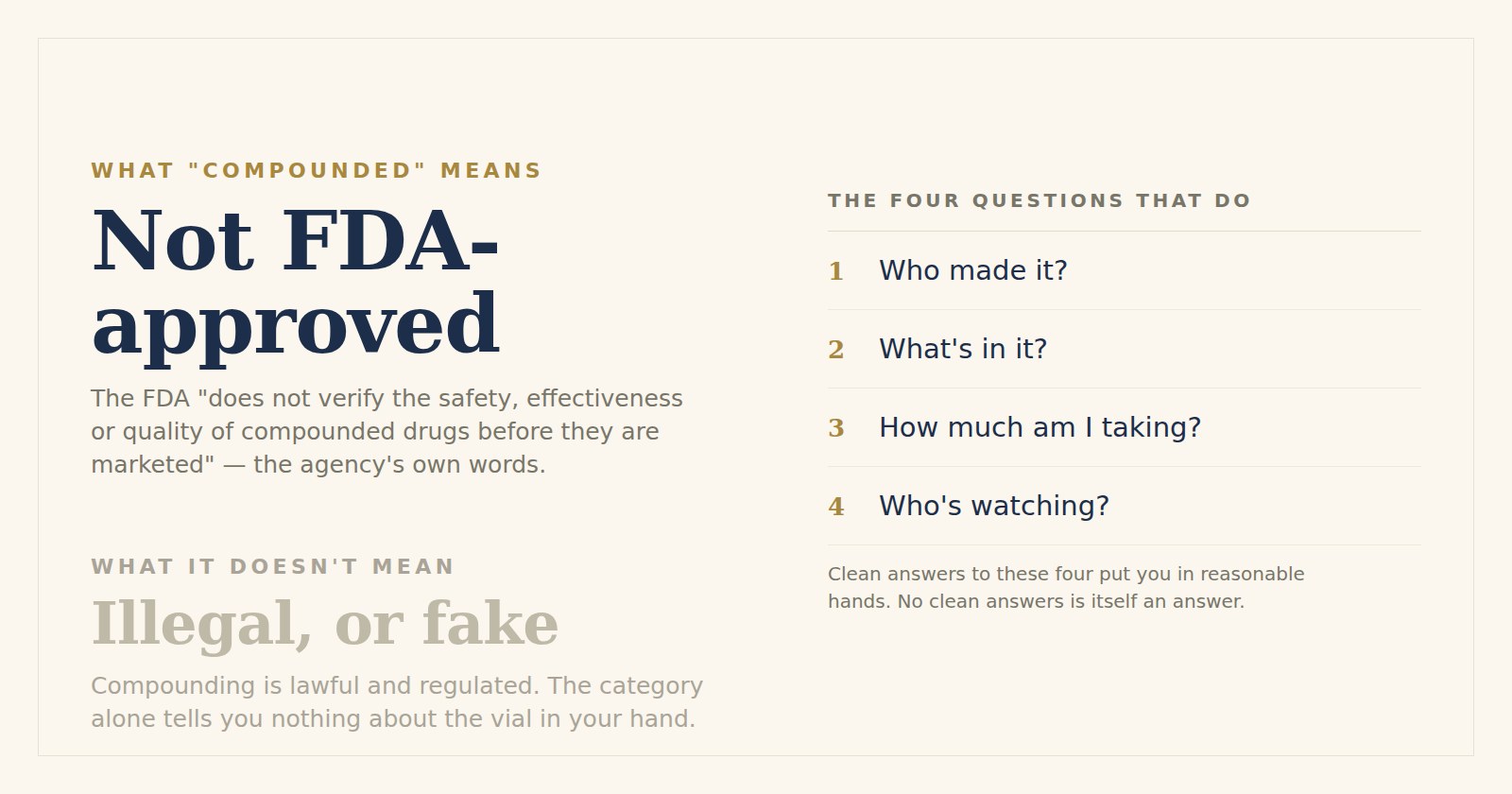
Here it is in the FDA's own words: "Compounded drugs are not FDA-approved. This means that FDA does not verify the safety, effectiveness or quality of compounded drugs before they are marketed."
I want to sit on that for a second, because it's the single most important sentence on this page and it gets buried or softened constantly.
It does not mean compounded medications are illegal, or fake, or that the pharmacy is doing something wrong. Compounding is a lawful, regulated activity and always has been.
It does mean that the layer of pre-market review you're used to — the one that reads the trial data, inspects the manufacturing, approves the labeling, and specifies exactly what's in the vial — was not applied to that particular preparation. The quality assurance that exists comes from the pharmacy's own practices, its state licensure, USP standards, and whatever testing it chooses to do. Those can be excellent. They can also be thin. The category doesn't tell you which.
Any clinic that isn't telling you this plainly is doing you a disservice, and I'd take it as information about the clinic.
Why a practice would use a compounded preparation at all
There are real clinical reasons, and they're worth naming so the honest ones don't get lumped in with the rest.
- A dose that isn't manufactured. Commercial products come in fixed tiers. Hormone therapy in particular often needs a strength between them, or below the lowest one.
- A different route or form. A cream, a troche, a sublingual preparation, a pellet — for absorption, tolerability, or because a patient won't reliably take the other thing.
- An excipient a patient reacts to. Dyes, preservatives, and fillers cause real problems for some people, and a compounded version can leave them out.
- Combining agents into one preparation to simplify a regimen someone otherwise won't stick to.
Those are the classic indications, and they're most of what compounding does in a practice like mine — particularly on the hormone side, where individualized dosing is the whole point.
Notice what isn't on that list: it's cheaper. Cost is a real pressure and I'm not going to pretend otherwise, but cost is not a clinical rationale, and a clinic that leads with price rather than fit is telling you what it's optimizing for.
The worked example: semaglutide
This is where most people arrive at this page, so let's take it directly.
Compounded semaglutide became widely available during a national shortage, under a federal policy that gave compounders room to operate while supply was constrained. That period ended. The FDA ended its enforcement discretion for compounded semaglutide on April 22, 2025 for 503A pharmacies and May 22, 2025 for 503B outsourcing facilities. Tirzepatide's dates were a month earlier. Those are not recent events — they are more than a year old as I write this.
Since then, federal law has continued to tighten. On April 30, 2026 the FDA proposed to keep semaglutide, tirzepatide and liraglutide off the 503B bulks list permanently, finding no clinical need for outsourcing facilities to compound them from bulk substances. The comment period closed on June 29, 2026. As of this writing the agency has not issued a final rule.
I'm laying out the timeline rather than arguing a position on it, and I want to be straight about why: whether any specific compounded preparation is lawfully dispensed to a specific patient is a determination that belongs in that patient's chart and in the pharmacy's records — not in marketing copy on a clinic website. Any page that tells you it has a clever general answer to that question is selling you something.
What I will say is this. If you have read that compounded GLP-1s were "legalized," or that they were "banned," both are oversimplifications of a situation that is genuinely unsettled and still moving. Ask your prescriber directly. A practice that can't answer the question about your own prescription, this month, isn't tracking it.
What actually goes wrong
Set the legal question aside entirely. Here is the safety picture, which is the part I can speak to as a physician and the part that should drive your decisions.
As of May 31, 2026, the FDA had received 990 adverse event reports involving compounded semaglutide and more than 730 involving compounded tirzepatide. Those are voluntary reports, which means the true number is higher and the denominator is unknown — you cannot turn them into a rate. But the patterns in them are instructive, and they cluster into four failure modes.
1. Dosing errors — the big one. This is not a subtle pharmacological risk; it's arithmetic, and it has put people in the hospital. Compounded products come in varying concentrations and are often drawn from a vial with a syringe rather than dialed on a pen. The approved products are dosed in milligrams; syringes are marked in units and milliliters. The FDA has reported patients drawing up five and ten times their intended dose, and prescribers miscalculating and writing doses beyond what appears in the approved label.
If you take one practical thing from this page, take this: know your concentration, and know how many units your dose is on the specific syringe you were given. Write it down. Confirm it with whoever prescribed it before your first injection. This single conversation prevents most of what shows up in those reports.
2. Salt forms. Some products have been made with semaglutide sodium or semaglutide acetate rather than the semaglutide base. The FDA's position is unambiguous: these salt forms "are different active ingredients" and their equivalence to the approved product is not established. This is worth asking about by name.
3. Sterility and handling. These are injectables, and injection bypasses defenses your gut would otherwise provide. The FDA advises discarding a multi-dose vial within 28 days of first use, and not using product that arrives warm or with inadequate ice packs. Shipping is a genuine weak point in any mail-order model, mine included — if a package shows up warm, call rather than shrug.
4. Additives. Compounded GLP-1s are frequently combined with other ingredients, most commonly vitamin B12. In March 2026, analytical work identified a previously unrecognized impurity formed by a chemical reaction between tirzepatide and certain B12 forms in compounded combination products. The clinical significance is unknown. I'd also want you to know that every author on that paper is employed by Eli Lilly, which manufactures the approved tirzepatide products — that doesn't make the chemistry wrong, but you should weigh it, and I'd rather tell you than have you find out later.
There's a fifth category that isn't compounding at all: products bought from online sellers labeled "for research use only" or "not for human consumption," and outright counterfeits carrying false label information and naming compounding pharmacies that don't exist. That isn't a compounded medication with a quality question. That's an unknown substance. Two entirely different risk conversations.
The questions to ask any clinic
This is the practical core, and I mean it to be used on me as much as on anyone else.
- Is what you're prescribing an FDA-approved product or a compounded preparation? If compounded, will you tell me plainly that it has not been evaluated by the FDA for safety, effectiveness, or quality?
- Which pharmacy is preparing it — by name — and is it a 503A pharmacy or a 503B outsourcing facility? "A licensed US pharmacy" is not an answer. A name is an answer.
- Is that pharmacy licensed in my state, and can I verify it? You can check with your state board of pharmacy directly. The National Association of Boards of Pharmacy also accredits compounding pharmacies against USP standards and publishes a searchable list of the ones that hold it — accreditation is voluntary, so its absence isn't disqualifying, but its presence tells you something.
- What concentration am I getting, and how many units is my dose on this syringe? Ask it out loud. Ask it again if the concentration changes.
- Does the pharmacy test for potency and sterility, and will you tell me what testing is done?
- What exactly is in it besides the active ingredient? If there are additives, why are they there and what's the evidence for adding them?
- Who is prescribing, are they licensed in my state, and will a physician review my history and labs?
- What's the monitoring plan, and what happens if something goes wrong at nine at night?
A clinic that welcomes these questions is one I'd trust further than a clinic with a smooth, pre-packaged answer to all of them.
Where the approved products fit
I don't think the honest position is that compounded is fine and brand is a ripoff, or that brand is real medicine and compounded is a shortcut. Both of those are sales pitches.
The FDA-approved products have something compounded preparations structurally cannot have: a body of trial evidence tied to that exact formulation, manufacturing held to CGMP, and a label that has been reviewed. If an approved product is accessible to you and you can afford it, wanting it is a completely reasonable preference and any physician worth seeing will say so rather than talking you out of it. Access and cost are real constraints for real people, and that's a conversation to have openly with a clinician who will lay out the trade-offs instead of steering you.
Where I land
Fifteen years in emergency medicine gave me a durable suspicion of confident answers to complicated questions. This is one of those questions.
Compounding is legitimate and useful, the oversight gap is real, the safety problems are mostly preventable and mostly about process rather than pharmacology, and the regulatory picture around GLP-1 medications specifically is not settled. Anyone telling you a simpler story than that is leaving something out.
What I can promise is the part I control: you'll be told what you're getting and who made it, in plain words, before you decide — and if the answer to a question is "we don't know yet," you'll hear that too.
Frequently asked questions
Is compounded semaglutide safe?
Compounded preparations are not reviewed by the FDA for safety, effectiveness, or quality before they're marketed, so the answer depends heavily on the pharmacy, the prescriber, and the handling — not on the category. The documented problems cluster in dosing errors, salt forms used in place of the base, sterility and shipping, and added ingredients. Most are preventable with a named pharmacy, a clear concentration, and physician oversight.
How does compounded semaglutide differ from the FDA-approved products?
The FDA-approved products have been through clinical trials as specific formulations and are manufactured under CGMP requirements; compounded preparations have not and are not. Some compounded products have also used salt forms, which the FDA describes as different active ingredients.
What's the difference between a 503A pharmacy and a 503B outsourcing facility?
503A compounders are state-licensed pharmacies preparing medications for individual identified patients, overseen primarily by state boards, and not subject to CGMP. 503B outsourcing facilities register with the FDA, are inspected by the FDA on a risk-based schedule, are subject to CGMP, and can compound without a patient-specific prescription. Neither produces FDA-approved drugs.
Why did compounded semaglutide become so common?
It expanded during a national shortage under a federal policy that gave compounders room to operate while supply was constrained. That enforcement discretion ended on April 22, 2025 for 503A pharmacies and May 22, 2025 for 503B outsourcing facilities.
How do I check whether a compounding pharmacy is legitimate?
Get the pharmacy's name, then verify its license with your state board of pharmacy. The National Association of Boards of Pharmacy also accredits compounding pharmacies against USP standards and publishes a list of those that hold it. If a clinic won't name the pharmacy, treat that as the answer.
What about peptides sold online as "research use only"?
That isn't compounding. Those are products of unknown identity, purity, and sterility sold outside the pharmacy system, and the FDA has issued warning letters to sellers stating that such labeling does not change what the products actually are.
Before you go
The reason I wrote this is that "is it safe?" isn't answerable as asked, and the people who benefit most from that ambiguity are the ones selling the least careful version of this care.
What's answerable is narrower and more useful: who made it, what's in it, how much am I taking, and who's watching. If you can get clean answers to those four, you're in reasonable hands. If you can't, that's your answer.
If you're in Texas and you'd like to work through this with a physician who will tell you where the uncertainty is rather than around it, that's what an initial visit is for.
Ozempic® and Wegovy® are registered trademarks of Novo Nordisk. Mounjaro® and Zepbound® are registered trademarks of Eli Lilly and Company. Billie Jean Health is not affiliated with, endorsed by, or sponsored by either company.
This article is for general education and is not medical advice for any individual. It doesn't establish a physician-patient relationship. Talk to a licensed clinician about your own situation.