

Last reviewed: September 2026
The short version
Starting testosterone is the easy part. What happens over the following years is where the difference between a practice and a prescription service actually shows.
Three things get monitored for good reasons: your red blood cell count, your prostate marker, and - new since 2025 - your blood pressure. One thing gets monitored constantly that neither major guideline recommends measuring routinely at all: estradiol.
And there is a fourth item that almost never gets raised, though the AUA guideline puts it in writing: if your symptoms have not improved once your level is normal, the appropriate conversation is about stopping, not about going higher.
What changed in 2025, and what most coverage missed
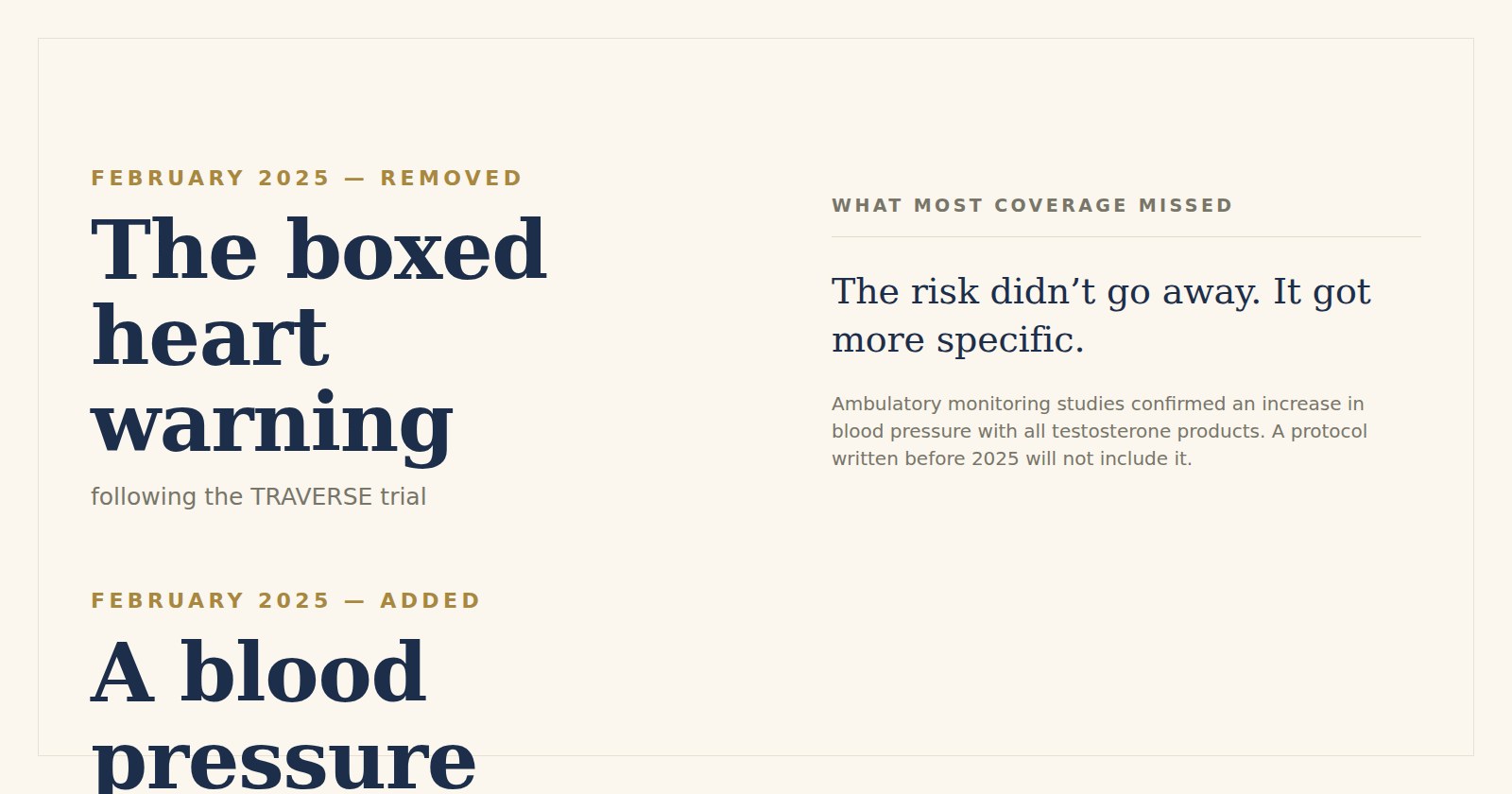
On 28 February 2025 the FDA made class-wide labeling changes to every testosterone product. It was widely reported as testosterone being cleared of heart risk. That is half of what happened.
The FDA did remove the boxed warning language about increased risk of adverse cardiovascular outcomes, following the TRAVERSE trial. It also, in the same action, required a new class-wide warning about increased blood pressure, because ambulatory blood pressure monitoring studies - the ones that measure pressure repeatedly across a full day rather than once in a clinic - confirmed an increase in blood pressure with all testosterone products.
So the accurate summary is not that the risk went away. It is that the risk got more specific: a broad cardiovascular warning was replaced by a narrower, better-characterised one about blood pressure. That is a meaningful improvement in what is known. It is not a clean bill of health, and a monitoring protocol written before 2025 will not include it.
If your blood pressure is not being checked on treatment, that is now a gap in the label's own terms.
The monitoring schedule
A few notes on the items in that table that are easy to misread.
Hematocrit
Testosterone stimulates red blood cell production. In some men that goes far enough to thicken the blood, which is called erythrocytosis and is conventionally marked at a hematocrit above 54%.
The AUA's position on the baseline measurement is one of its strongest: measuring haemoglobin and hematocrit before offering testosterone therapy, and informing the patient about the increased risk of polycythemia, is a Strong Recommendation graded A. Once above threshold on treatment, dose adjustment is the usual first response rather than immediate cessation.
This is the single most common reason a well-run practice changes a dose, and it is invisible without the test.
PSA
The Endocrine Society is specific about what should prompt a referral rather than a shrug. It recommends urological consultation if, during the first twelve months of treatment, there is a confirmed PSA increase of more than 1.4 ng/mL above baseline, a confirmed PSA above 4.0 ng/mL, or a prostate abnormality on examination.
Two things follow. You need a baseline PSA to detect a rise from it — which is why the AUA calls for measuring it in men over 40 before starting. And “confirmed” is doing real work: a single elevated reading is repeated before anyone acts on it.
Testosterone itself
The target both guidelines describe is the mid-normal range, not the top of it and not above it. The AUA recommends an initial follow-up level after an appropriate interval to confirm the target has been reached, and levels every 6 to 12 months thereafter.
When the level is drawn matters, and it depends on the formulation - injections produce peaks and troughs that gels largely do not. A number drawn the day after an injection and a number drawn the day before it are describing different points on the same curve. This is the same measurement problem we covered in reading a testosterone result, arriving from the other direction.
The estradiol question
This is where guidelines and common practice diverge most sharply, so it is worth stating plainly.
Neither the Endocrine Society guideline nor the AUA guideline recommends routine estradiol measurement in men on testosterone therapy, and neither recommends routine aromatase inhibitor use to suppress it.
Yet estradiol appears on a great many TRT panels, and anastrozole is co-prescribed widely, frequently on the strength of a number rather than a symptom. The reasoning offered is usually that estradiol is a by-product of testosterone and should be kept low. The reasoning against is that estradiol in men is not a waste product — it has roles in bone density, lipids and libido — and that suppressing it because a number looks high, in a man with no symptoms attributable to it, treats the printout.
Look at how that sorts. The strongest recommendation in the whole monitoring picture concerns a test done before the first dose. The intervals afterwards rest on expert opinion, the weakest tier — which is honest of the guidelines, and worth knowing when someone quotes a schedule at you as though it were settled. And the tests most likely to generate a second prescription are the ones with no recommendation behind them at all.
Your formulation changes what monitoring means
The same schedule produces different numbers depending on how the testosterone is delivered, and this is a common source of confusion.
Injections produce a peak in the days after the dose and a trough before the next one. A level is only interpretable if you know where in that cycle it was drawn, and comparing a peak to a previous trough will suggest a change that has not happened.
Gels and other transdermals give steadier concentrations, so timing matters less — but they carry their own consideration, which is transfer to other people through skin contact. Application site, covering the area, and handwashing are part of using them safely, and it is worth asking about if there are children or a partner in the household.
Pellets deliver over months, which means a level reflects where you are in a long cycle and a dose cannot be adjusted quickly if something moves in the wrong direction.
None of this makes one formulation right. It means the monitoring conversation should include when your level is drawn relative to your dose, and a practice that does not ask is not really reading the result.
What else belongs on the radar
- Fertility, which is a separate question with its own monitoring and its own urgency. If it is relevant to you at all, it belongs in the first conversation rather than a later one — we covered why in its own piece.
- Sleep apnoea, which can be worsened by testosterone and is worth revisiting if snoring, daytime sleepiness or a partner's account of your breathing change.
- Breast tenderness or enlargement, which is a symptom to report rather than a number to chase - and the appropriate response is a conversation, not an automatic aromatase inhibitor.
- Mood and irritability, which patients notice and reviews frequently forget to ask about.
The conversation nobody has
AUA Statement 31 recommends discussing cessation of therapy if symptoms have not improved despite testosterone levels having been normalised.
That sentence describes a genuinely common situation. A man starts treatment for fatigue, low mood and poor concentration. His level comes up nicely. He feels roughly the same. The usual next move is a higher dose, then a higher one, then estradiol management, then something else added on.
The guideline's move is different: if the level is corrected and the symptoms are not, testosterone was probably not the cause of the symptoms, and the honest response is to say so and look elsewhere. Sleep apnoea, depression, thyroid disease, alcohol, and several common medications all produce that symptom cluster - we listed them in the piece on causes and evaluation.
Escalating a treatment that is not working is not persistence. It is a failure to revisit the diagnosis.
What good monitoring actually looks like
- A real baseline before the first dose: haemoglobin and hematocrit, PSA if over 40, blood pressure, and the tests that explain why the level is low rather than merely confirming that it is.
- An early check after starting to confirm the target has been reached and nothing has moved in the wrong direction.
- A settled interval thereafter, with the level drawn at a consistent point relative to your dose.
- The same laboratory each time, so a change means something.
- Blood pressure at every contact, which since 2025 is a labeled class-wide effect rather than an optional extra.
- A named review point where the question is whether the treatment is working, not only whether the numbers look right.
Most of that is unglamorous, and it is the part that separates ongoing care from a subscription. It is also why the evaluation comes before the prescription — without a baseline, half of these checks have nothing to compare against.
Questions worth asking your prescriber
- What is my baseline hematocrit and PSA, and when will they next be checked?
- Is my blood pressure being monitored, given the 2025 labeling change?
- When should my testosterone level be drawn relative to my dose?
- If estradiol is on my panel, what decision will the result change?
- At what point would we conclude this is not working and stop?
That last one is the most useful question in the list, and the least often asked.
Where I land
Monitoring on testosterone is not complicated, and the guidelines are clearer than the market suggests. Check the blood count, check the prostate marker, check the blood pressure, get the level into the mid-normal range and leave it there, and be willing to conclude that it is not the answer if the symptoms do not follow.
Be more suspicious of a protocol that adds tests and medications than of one that does not. The tests with the strongest recommendations behind them are cheap, few, and mostly done before you start.
Frequently asked questions
What blood tests do I need while on testosterone?
The core set is testosterone itself, haemoglobin and hematocrit, and PSA in men over 40. The AUA recommends measuring haemoglobin and hematocrit before starting as a Strong Recommendation, and testosterone levels every 6 to 12 months on treatment. Blood pressure should also be monitored, following the FDA's February 2025 class-wide labeling change. Your prescriber may add tests for reasons specific to you.
Why is hematocrit checked?
Testosterone increases red blood cell production, and in some men this leads to erythrocytosis, conventionally defined as a hematocrit above 54%. It is the most common reason a dose is adjusted, and it cannot be detected without the test. Dose adjustment is generally the first response rather than stopping treatment outright.
What PSA change matters?
The Endocrine Society recommends urological consultation if, during the first twelve months of treatment, there is a confirmed increase of more than 1.4 ng/mL above baseline, a confirmed PSA above 4.0 ng/mL, or a prostate abnormality found on examination. A baseline measurement is needed for the first of those to be meaningful, and a single high reading is confirmed before anyone acts on it.
Do I need my estradiol checked?
Neither the Endocrine Society nor the AUA guideline recommends routine estradiol measurement in men on testosterone therapy, and neither recommends routine aromatase inhibitor use. Estradiol in men has roles in bone density, lipids and libido, so suppressing it on the basis of a number alone, without symptoms attributable to it, is treating the result rather than the patient. If it is on your panel, it is reasonable to ask what decision the result will change.
Did the FDA say testosterone is safe for the heart now?
Not quite. On 28 February 2025 the FDA removed boxed warning language about increased cardiovascular risk following the TRAVERSE trial, and in the same action required a new class-wide warning about increased blood pressure, because ambulatory monitoring studies confirmed a blood pressure increase with all testosterone products. The risk became more specific rather than disappearing.
My level is normal but I still feel the same — should the dose go up?
Not automatically. AUA Statement 31 recommends discussing cessation of therapy if symptoms have not improved despite normalised testosterone levels. If the level is corrected and the symptoms are not, testosterone may not have been the cause, and conditions such as sleep apnoea, depression and thyroid disease produce a very similar picture. That is a conversation to have rather than a dose to increase.
Before you go
If you are already on testosterone and cannot answer when your hematocrit was last checked, or whether your blood pressure is being followed, those are reasonable things to ask about at your next contact — and reasonable things to expect an answer to.
This article is for general education and is not medical advice for any individual. It doesn't establish a physician-patient relationship. Talk to a licensed clinician about your own situation.