

Last reviewed: September 2026
The short version
Most men arrive at this question holding a single number and a printed reference range, and want to know which side of the line they are on.
The honest answer is that there are two lines, they are in different places, and they are answering different questions.
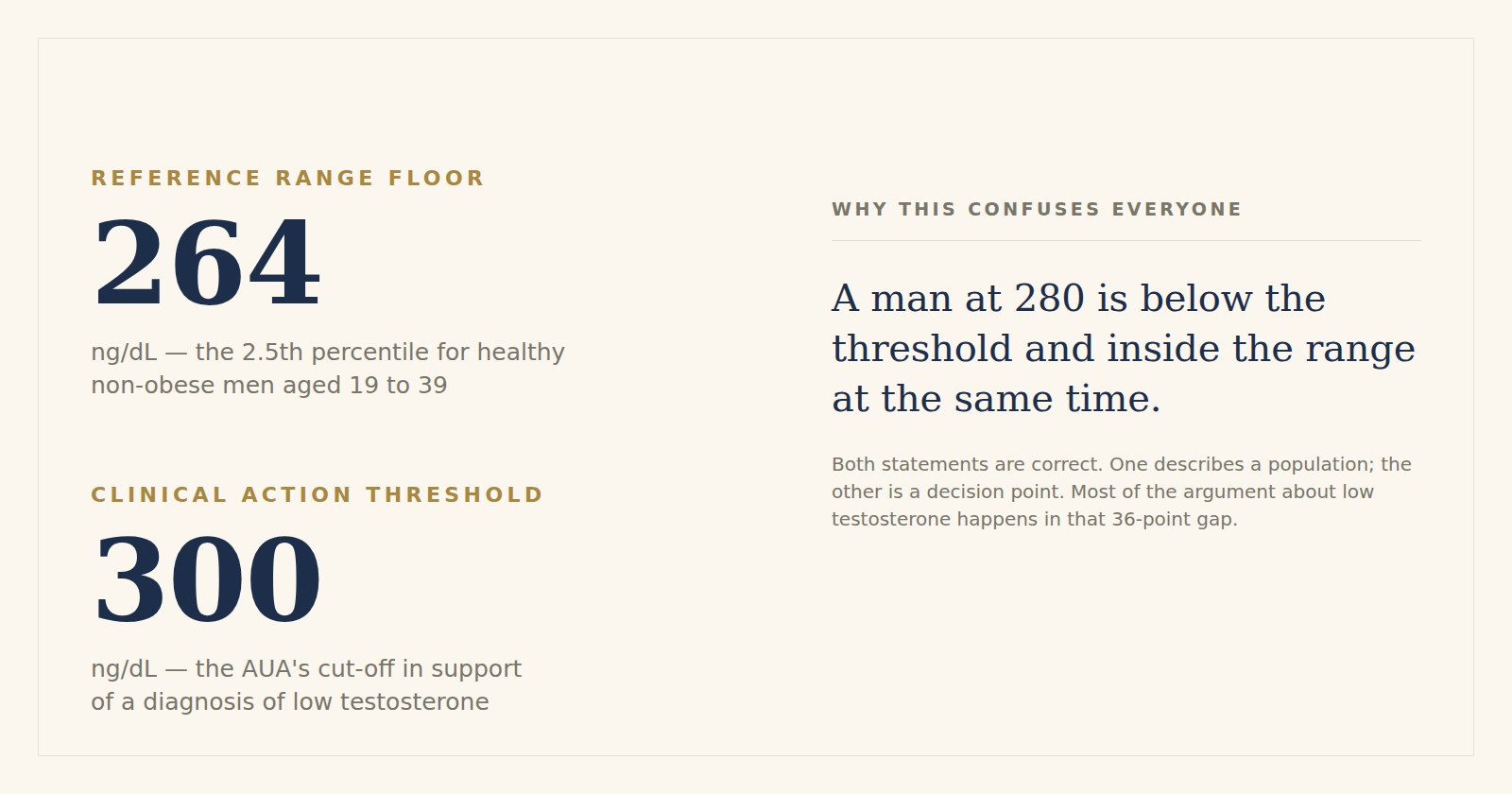
264 ng/dL is the bottom of the harmonized reference range — the 2.5th percentile for healthy non-obese men aged 19 to 39, derived from four large cohorts and standardised against a CDC reference method. It describes where the population sits.
300 ng/dL is the figure the American Urological Association calls a reasonable cut-off in support of a diagnosis of low testosterone. It is a clinical action threshold, not a percentile.
So a man at 280 is below the treatment threshold and inside the reference range at the same time. Neither the lab nor the guideline is wrong. They are measuring different things, and a great deal of confusion — and a certain amount of marketing — lives in the gap between them.
Two further things matter more than the number itself. One measurement is not a result: the guidelines require two, both early morning, and the Endocrine Society specifies fasting. And the free testosterone on most panels is a test both major guidelines advise against relying on — which we will come to, because it is the part with the widest gap between what is marketed and what is recommended.
Why one number is not a result
Testosterone is not a stable quantity you carry around. It varies across the day, peaking in the morning, and it varies from one day to the next in the same man. Acute illness lowers it. So does poor sleep the night before.
Both guidelines respond to this the same way. The AUA states that the diagnosis should be made only after two total testosterone measurements taken on separate occasions, both in an early morning fashion. The Endocrine Society recommends measuring total testosterone on two separate mornings with the patient fasting.
There is a third instruction that gets ignored more often than either: use the same laboratory and the same instrument for serial measurements. Different assays give different answers on the same blood. A number that appears to have dropped 60 points may have done nothing except change laboratories.
If you have one afternoon result from a walk-in panel, you do not yet have the information the guidelines are built on. That is not a criticism of you — it is the most common way this test is ordered.
Total, free, and why they disagree
Total testosterone measures everything in the sample. Most of it is not available to your tissues, because most of it is bound — tightly to sex hormone-binding globulin, and loosely to albumin. Free testosterone is the small unbound fraction.
When total and free disagree, SHBG is almost always the reason. And SHBG moves for a long list of reasons, most of which are conditions you have rather than things you did.
Read that list and a pattern emerges. Obesity and diabetes lower SHBG, which lowers total testosterone while free testosterone may be comparatively preserved — so the total looks worse than the biology. Ageing raises SHBG, which can prop up a total while the free fraction falls — so the total looks better than the biology.
This is why two men with identical total testosterone can be in genuinely different situations, and why the panel that measures only a total is answering half the question.
The part that contradicts a lot of marketing
Free testosterone is widely advertised as the number that really matters. Both major guidelines are more careful than that, in two separate ways.
On whether to lead with it. The AUA panel does not recommend using free testosterone measurements as the primary diagnostic method for testosterone deficiency. It positions free testosterone as useful in specific circumstances — when the total sits in an equivocal band, roughly 230 to 317 ng/dL, or in a highly symptomatic man whose total is low-normal.
On how it is measured. The Endocrine Society is blunt. The recommended method is equilibrium dialysis performed under standardised conditions; where that is unavailable, free testosterone should be estimated using a formula that calculates it accurately from total testosterone, SHBG and albumin. And then this, verbatim: “FT measurements by direct tracer analog immunoassays are frequently available in local and some reference laboratories, but these direct immunoassays are inaccurate and should not be used.”
That last sentence is the one worth carrying with you. The direct analog immunoassay is cheap and fast, which is why it is common on commercial panels — often printed simply as “Testosterone, Free, Direct.” It is the test a guideline says should not be used, and it appears on a great many results that men are shown and asked to make decisions about.
What to look for on your own result
- Was it drawn in the morning? The collection time is usually printed on the report.
- Is there a second one? A single result is a screening finding, not a diagnosis.
- Does the panel include SHBG? Without it, a calculated free testosterone cannot be produced.
- If free testosterone is reported, how was it measured? Equilibrium dialysis, or calculated from SHBG and albumin, is what the guidelines support. “Direct” analog is not.
- Is it the same lab as last time? If not, the comparison is weaker than it looks.
A note on units
Most US laboratories report total testosterone in nanograms per decilitre. Some report nanomoles per litre, and a result that looks alarmingly small may simply be in different units.
The conversions for the numbers above: 264 ng/dL is about 9.2 nmol/L, 300 ng/dL is about 10.4 nmol/L, and 916 ng/dL is about 31.8 nmol/L. If your result is a single- or low-double-digit number, check the units before drawing any conclusion from it.
The case that catches people out: weight
This one deserves its own section, because it is common and because it runs in a direction most men do not expect.
Obesity lowers SHBG, and it lowers total testosterone. A man carrying substantial excess weight will frequently produce a total testosterone below the threshold on a morning draw — and the finding is real, not an artefact. What is less obvious is that the free fraction is often better preserved than the total suggests, and that the low total is at least partly a consequence of the weight rather than an independent problem alongside it.
The practical consequence is that the sequence matters. A man whose total testosterone is low in the setting of significant obesity is in a different situation from a man with the same number and a normal BMI, and the guidelines treat him differently. Meaningful weight loss — by any route, including medical weight management — commonly raises total testosterone, which is one reason a level measured during active weight change is a moving target rather than a fixed characteristic.
None of that means a low number in a heavier man should be ignored. It means the question “why is this low” has a likely answer that is worth addressing on its own terms, and that a level rechecked after weight has changed may be a different level.
The age question
The harmonized study did publish reference ranges by decade, so age-specific numbers exist and are legitimate for describing populations.
The diagnostic threshold is not age-adjusted, and that is deliberate. Whether a level is low for your age and whether it warrants treatment are different questions, and a lower average among older men is a description of ageing rather than a licence to treat toward a younger man's number.
Watch for the reverse of this argument too. A clinic that quotes an age-adjusted range to argue that a normal result is actually low has mixed the two constructs in the direction that sells more treatment. The same mixing in the other direction — dismissing a genuinely symptomatic man because he is above a population floor — is equally sloppy.
What the number does not tell you
A great deal, as it turns out.
It does not tell you why. A low total testosterone can reflect the testes, the pituitary, or something entirely separate that is suppressing the axis — and the workup differs completely depending on which. We covered the reversible contributors in the piece on symptoms, causes and evaluation: sleep apnoea, alcohol, opioids, weight, acute illness, several common medications. Treating a number without asking why it is low is the most common shortcut in this field.
It does not tell you whether treatment will help your symptoms, because the symptoms that bring men in — fatigue, low mood, poor concentration, reduced libido — overlap heavily with sleep disorders, depression, thyroid disease and simply being unwell.
And it does not, on its own, establish a diagnosis. Both guidelines require symptoms and confirmed biochemical deficiency. A number without symptoms is a number.
Why this is on a lab panel before anything else
The whole reason careful practices insist on bloodwork before treatment is that everything above has to happen before a decision, not after one. A morning draw, repeated, at one laboratory, with SHBG where it is needed, alongside the other tests that explain a low result rather than merely confirming it.
It is slower than a same-day prescription. It is also the difference between treating a condition and treating a printout.
Questions worth asking about your own result
- Was this drawn in the morning, and fasting?
- Do we have a second measurement, and was it from the same laboratory?
- Was SHBG measured, and if free testosterone was reported, by what method?
- What else on this panel might explain a low result?
- Which of my symptoms would you expect this level to be causing — and which would you not?
Where I land
The number matters less than the conditions it was produced under. Morning, twice, fasting, same lab, with SHBG where the picture is unclear, interpreted next to symptoms and next to the other things that lower testosterone.
Two lines exist on your report and they mean different things. Knowing that is most of what stands between an informed conversation and being sold something on the strength of one afternoon blood draw.
Frequently asked questions
What is a normal testosterone level?
The harmonized reference range for healthy non-obese men aged 19 to 39 is 264 to 916 ng/dL, with a median around 531, standardised against a CDC reference method across four large cohorts. That describes a population. It is not the same as the treatment threshold, and a result inside the range does not automatically mean nothing is wrong, just as one below it does not automatically mean treatment is indicated.
Is 300 ng/dL the cut-off for low testosterone?
The American Urological Association describes a total testosterone below 300 ng/dL as a reasonable cut-off in support of a diagnosis of low testosterone. It is a clinical action threshold rather than a statistical boundary, which is why it sits slightly above the bottom of the harmonized reference range of 264. Both figures are correct and they answer different questions.
Why do I need two blood tests?
Testosterone varies across the day and from day to day, and acute illness lowers it. The AUA states the diagnosis should be made only after two total testosterone measurements on separate occasions, both early morning. The Endocrine Society recommends two separate fasting mornings. A single result is a screening finding.
What is SHBG and why does it matter?
Sex hormone-binding globulin binds most of the testosterone in your blood, leaving a small free fraction. When SHBG is high or low, total and free testosterone diverge. Obesity, diabetes, hypothyroidism, nephrotic syndrome, acromegaly and certain steroids lower it; ageing, hyperthyroidism, cirrhosis and hepatitis, HIV, estrogen use and some anticonvulsants raise it. Without SHBG, a calculated free testosterone cannot be produced.
Is free testosterone the number that really matters?
Not as a first step. The AUA does not recommend free testosterone as the primary diagnostic method, positioning it instead for equivocal totals of roughly 230 to 317 ng/dL or highly symptomatic men with low-normal totals. Method matters too: the Endocrine Society recommends equilibrium dialysis, or an accurate calculation from total testosterone, SHBG and albumin, and states that direct tracer analog immunoassays are inaccurate and should not be used.
My lab says Testosterone, Free, Direct — is that the right test?
That naming usually indicates a direct analog immunoassay, which is the method the Endocrine Society guideline says should not be used. It is common on commercial panels because it is inexpensive. If a decision is going to rest on a free testosterone value, it is worth asking whether it was measured by equilibrium dialysis or calculated from SHBG and albumin instead.
Before you go
Nothing here interprets your particular result, and it deliberately stops short of telling you whether your level is a problem. That depends on your symptoms, the conditions the draw was taken under, and what else is on the panel. What this is for is knowing which questions make that conversation a good one.
This article is for general education and is not medical advice for any individual. It doesn't establish a physician-patient relationship. Talk to a licensed clinician about your own situation.