

I'm Dr. Lauren Leavitt. I spent about fifteen years in emergency medicine before founding Billie Jean Health, and one of the questions I get asked most often - usually within the first ten minutes of a visit - is some version of: "what is this medication doing to me?"
Fair question. Most of the answers online are either a pharmacology lecture or a sales pitch. Let me try for something in between.
The short answer
Semaglutide and tirzepatide work by imitating hormones your small intestine already releases when you eat.
Those hormones - GLP-1, and in tirzepatide's case GIP as well - are part of how your body tells your brain that food has arrived and that you can stop. The medications bind to the same receptors those hormones use. The result, for most people, is that hunger arrives later, meals end sooner, and the mental background noise about food gets quieter.
That's the whole idea. Not a stimulant. Not a fat burner. A hormone signal, extended.
The longer answer is more interesting, and it matters, because understanding the mechanism is what makes the side effects, the slow dose titration, and the honest limitations make sense instead of feeling arbitrary.
GLP-1 is something your body already makes
Glucagon-like peptide-1 is a gut hormone. It's produced by specialized cells called L cells, which sit in the lining of your lower small intestine and colon. When nutrients from a meal reach them, they release GLP-1 into the bloodstream.
A closely related hormone, GIP (glucose-dependent insulinotropic polypeptide), comes from K cells higher up - in the duodenum and jejunum. Together these two are called the incretin hormones, and they do a surprising amount of work. In healthy adults, the incretin response accounts for roughly half to two-thirds of the insulin your body releases after a meal, according to a 2024 review in Frontiers in Endocrinology. In people with type 2 diabetes, that contribution appears to be substantially blunted.
Here's the catch with your own GLP-1: it doesn't last. An enzyme called DPP-4 begins breaking it down within minutes of release. The signal is real, but it's brief by design.
That's the single most useful thing to understand about these medications. They aren't introducing a foreign instruction to your body. They're taking a message your gut already sends and keeping it legible for a week instead of a few minutes.
Think of satiety as a text message from your gut to your brain saying "the food got here, you can stand down." In some people that message arrives faint, or late, or gets deleted before it's read. These medications don't write a new message. They keep the existing one on the screen long enough to register.
What the medications do once they're in you
Semaglutide is described in FDA labeling as a GLP-1 analogue sharing 94% of its sequence with human GLP-1, modified so it resists that DPP-4 breakdown. Its elimination half-life is about one week — which is why it's a once-weekly injection, and also why the labeling notes it remains in circulation for roughly five to seven weeks after a final dose.
Once it's binding GLP-1 receptors, several things happen at once.
1. Appetite signaling in the brain
GLP-1 receptors are present in the regions of the brain that govern food intake. FDA labeling for semaglutide states that it is distributed to the brain and activates neurons in areas involved in regulating food intake, and that it reduces calorie intake through effects on appetite.
There's a useful human study behind this. In a crossover trial published in Diabetes, Obesity and Metabolism in 2017, Blundell and colleagues gave 30 adults with obesity either semaglutide (escalated to 1.0 mg weekly) or placebo over 12 weeks and then simply let them eat. On semaglutide, total daily energy intake at free-access meals fell by about 24% compared with placebo — roughly 35% at the lunch meal specifically. Participants reported less hunger, better control of eating, and fewer cravings.
Nobody was told to eat less. They just did.
2. Slower gastric emptying
GLP-1 slows the rate at which the stomach hands food off to the intestine. FDA labeling for semaglutide states plainly that it delays gastric emptying.
Practically, a meal sits longer and fullness lasts longer. It's also the reason nausea is the most common side effect. The same mechanism produces both the benefit and the complaint.
Worth noting: a 2025 review in Endocrinology found that long-acting agents like semaglutide produce a more modest delay than short-acting ones - up to about a 1.6-fold increase in gastric half-emptying time - and that the effect may diminish with continued treatment. That aligns with what I see clinically: the early weeks are usually the hardest.
3. Insulin and glucagon - but only when needed
GLP-1 stimulates the pancreas to release insulin and suppresses glucagon, the hormone that tells the liver to push glucose out.
The important word is glucose-dependent. GLP-1's insulin effect scales with your blood sugar: strong when glucose is high, quiet when it's normal or low. That built-in brake is why these medications carry a low risk of hypoglycemia on their own - the meaningful risk comes when they're combined with insulin or a sulfonylurea, which is why your full medication list matters at the first visit.
4. Food reward, not just hunger
This is the part patients describe most vividly and the part the science is still filling in. Many people report that food stops occupying so much mental real estate — the term people use is "food noise."
The Blundell data offer a hint of what's underneath: participants on semaglutide showed lower explicit liking and lower implicit wanting for high-fat, non-sweet foods. Not just less hunger — a shift in what appealed.
I'll be careful here, because marketing has outrun the evidence on this one. The observation is consistent across many patients. The mechanism is still being worked out.
Where tirzepatide differs: the second receptor
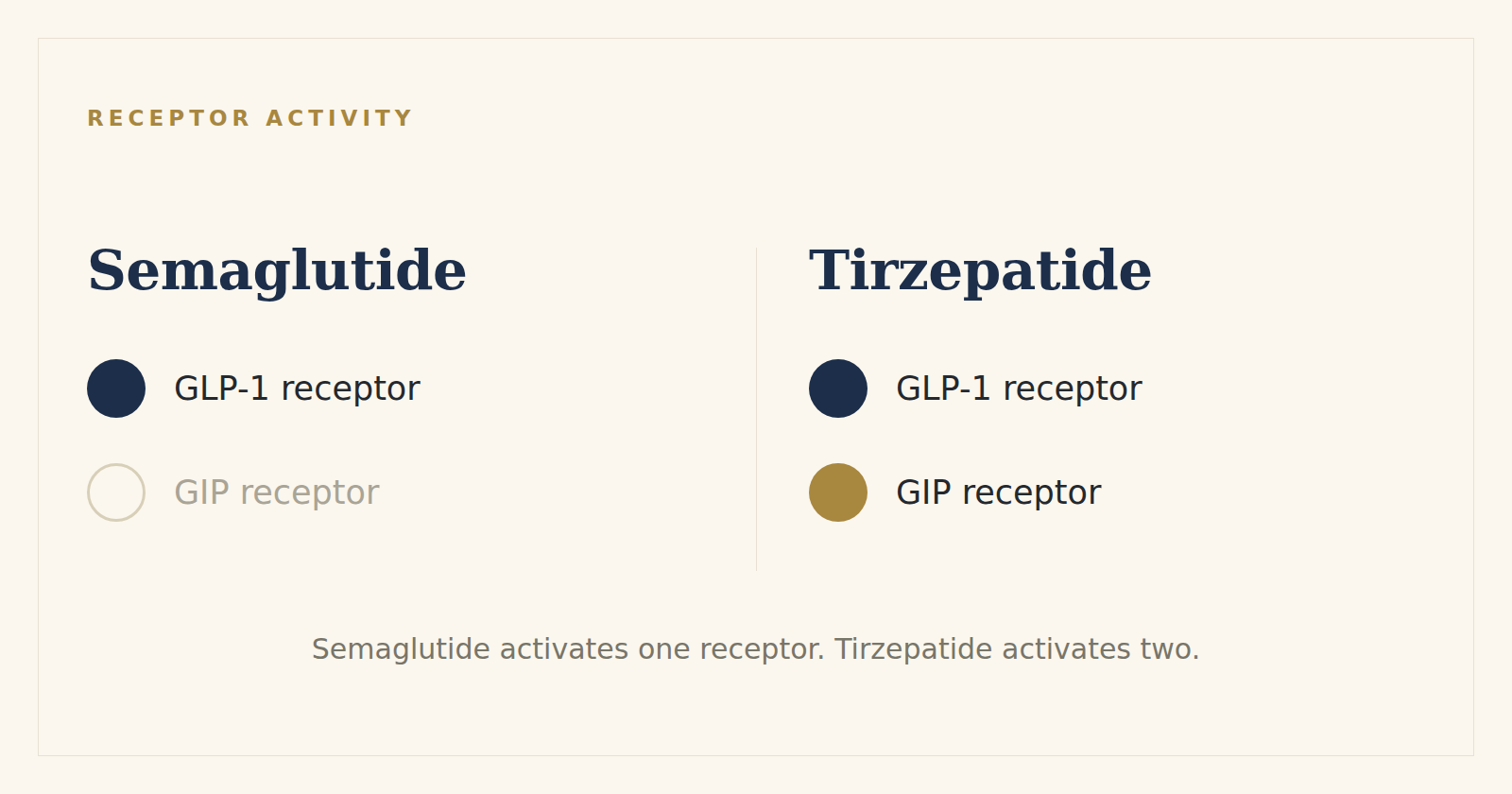
Tirzepatide is a single molecule that activates two receptors - the GLP-1 receptor and the GIP receptor. FDA labeling describes it as a GIP receptor and GLP-1 receptor agonist. Its half-life is roughly five to six days.
What does the second receptor add? Research suggests a few things - some of this is still mechanistic hypothesis rather than settled fact:
- In fat tissue. GIP appears to improve how adipose tissue handles nutrients — enhancing triglyceride uptake and improving insulin sensitivity in fat cells — while GLP-1 signaling favors fat mobilization. The two may complement each other.
- In the brain. A 2024 Frontiers in Endocrinology review describes evidence that GIP may amplify GLP-1's reduction in food intake by acting on a distinct population of hypothalamic neurons.
- Possibly in nausea circuitry. The same review notes evidence that GIP receptor activation may dampen nausea and vomiting signals in the brainstem region that controls them. This is a real and interesting hypothesis. It is not settled.
There's also a design detail worth knowing. A 2020 JCI Insight study by Willard and colleagues found tirzepatide is an "imbalanced" dual agonist: it binds the GIP receptor with affinity comparable to native GIP, but binds the GLP-1 receptor about five-fold more weakly than native GLP-1. It leans on GIP more than GLP-1 at the receptor level - not an accident of chemistry, but how the molecule was built.
Semaglutide and tirzepatide side by side
Ozempic® and Wegovy® are registered trademarks of Novo Nordisk. Mounjaro® and Zepbound® are registered trademarks of Eli Lilly and Company. Billie Jean Health is not affiliated with, endorsed by, or sponsored by either company. These brand names appear here only because they're the names most readers recognize.
This is physiology, not willpower
I want to sit on this for a second, because it's the part that changes how people feel about themselves.
Appetite is not a character trait. It is a regulated system - hormones from the gut, signals from fat tissue, receptors in the hypothalamus and brainstem — and like any regulated system, it can run at a set point that works against you. When someone loses weight, that system fights to restore what was lost. That's not weakness. That's a control loop doing its job.
What these medications do is act on the control loop itself. In my experience, that reframe is worth as much to patients as the weight is.
What the trials showed, on average
Some real numbers, with the framing that matters: these are averages from controlled trials, and individual results vary considerably.
What these medications don't do
They don't fix the underlying set point permanently. When treatment stops, the physiology returns.
In the STEP 1 trial extension published in 2022, participants followed for a year after stopping semaglutide regained about two-thirds of the weight they had lost, ending at −5.6% from their original baseline. In STEP 4 (JAMA, 2021), people who continued semaglutide after a 20-week run-in lost a further 7.9% on average over the next 48 weeks, while those switched to placebo regained 6.9%.
I don't share that to discourage anyone. I share it because it tells you what kind of thing this is: a treatment for a chronic, regulated condition, not a course of antibiotics. That's a conversation worth having before you start.
They also aren't a substitute for protein intake, resistance training, or sleep. Weight lost on these medications includes lean mass along with fat, and how you eat and train during treatment shapes that ratio.
Who these aren't for
These medications are not appropriate for everyone. FDA labeling for both contraindicates them in people with a personal or family history of medullary thyroid carcinoma or Multiple Endocrine Neoplasia syndrome type 2, and in anyone with a known serious hypersensitivity to the drug. Labeling also states they are not recommended in severe gastroparesis, and directs that they be discontinued in pregnancy.
Other situations - a history of pancreatitis, active gallbladder disease, certain eating disorder histories, concurrent insulin or sulfonylurea therapy, plans for pregnancy - aren't automatic no's, but they do require a physician who knows your history to weigh them. That's the entire point of an initial visit.
A note on compounded medications
Some practices, including mine, work with compounded formulations of semaglutide and tirzepatide.
You should know exactly what that means. Compounded medications are not FDA-approved finished drug products. FDA does not review compounded drugs for safety, effectiveness, or quality before they are marketed. FDA has also published concerns about the unapproved GLP-1 market specifically, including reports of dosing errors, improper storage, and counterfeit products.
That's not a footnote - it's information you're entitled to before you decide anything. The variable that matters most is whether a licensed physician reviewed your history and your labs, set your dose, and is reachable when something feels off.
Frequently asked questions
How is semaglutide related to Ozempic®?
Semaglutide is a drug substance. Novo Nordisk manufactures two FDA-approved products that contain it, Ozempic® and Wegovy®. A compounded preparation containing semaglutide is a different, non-FDA-approved product and should not be described as a generic version of any brand drug.
Does tirzepatide work better than semaglutide?
In SURMOUNT-5, the only large head-to-head trial to date, average weight reduction over 72 weeks was greater with tirzepatide (−20.2%) than with semaglutide (−13.7%). Averages describe groups, not individuals. Tolerability, medical history, and access all factor into which agent suits a given person - that's a clinical decision.
How long does it take to work?
Appetite changes are often noticeable within the first few weeks, but doses are escalated gradually over several months per FDA labeling, specifically to reduce GI side effects. The trial results above reflect 68 to 72 weeks of treatment.
Do these medications work if I only need to lose a modest amount of weight?
Whether treatment is appropriate depends on your BMI, your medical history, and your other conditions — not on a number you picked. That's a determination a physician has to make with you.
Will I be on this forever?
This is the question I'm asked most. Obesity behaves like a chronic condition, and the withdrawal data above show what typically happens when treatment stops. Some people transition to lower maintenance dosing. Some stop. What I won't do is promise you an off-ramp before we've seen how your body responds.
Are there people who don't respond?
Yes. A meaningful minority of people in these trials did not reach the average results. Results vary, and anyone who tells you otherwise is selling something.
If you're wondering whether this is right for you
That's exactly what an initial visit is for.
I can't tell you from a blog post whether a GLP-1 medication belongs in your care. What I can tell you is what a real evaluation looks like: your history, your labs, your medication list, your goals, and a frank conversation about what the evidence supports and what it doesn't - including the possibility that the answer is no, or not yet, or something else first.
Billie Jean Health is a physician-led telehealth practice serving patients in Texas. If you have questions, ask them. I tell my patients they're never bothering me, and I mean it.
This article is for general education and is not medical advice for any individual. It doesn't establish a physician-patient relationship. Talk to a licensed clinician about your own situation.