

Last reviewed: September 2026
The short version
Lifting weights while you are losing weight will not make you lose more weight.
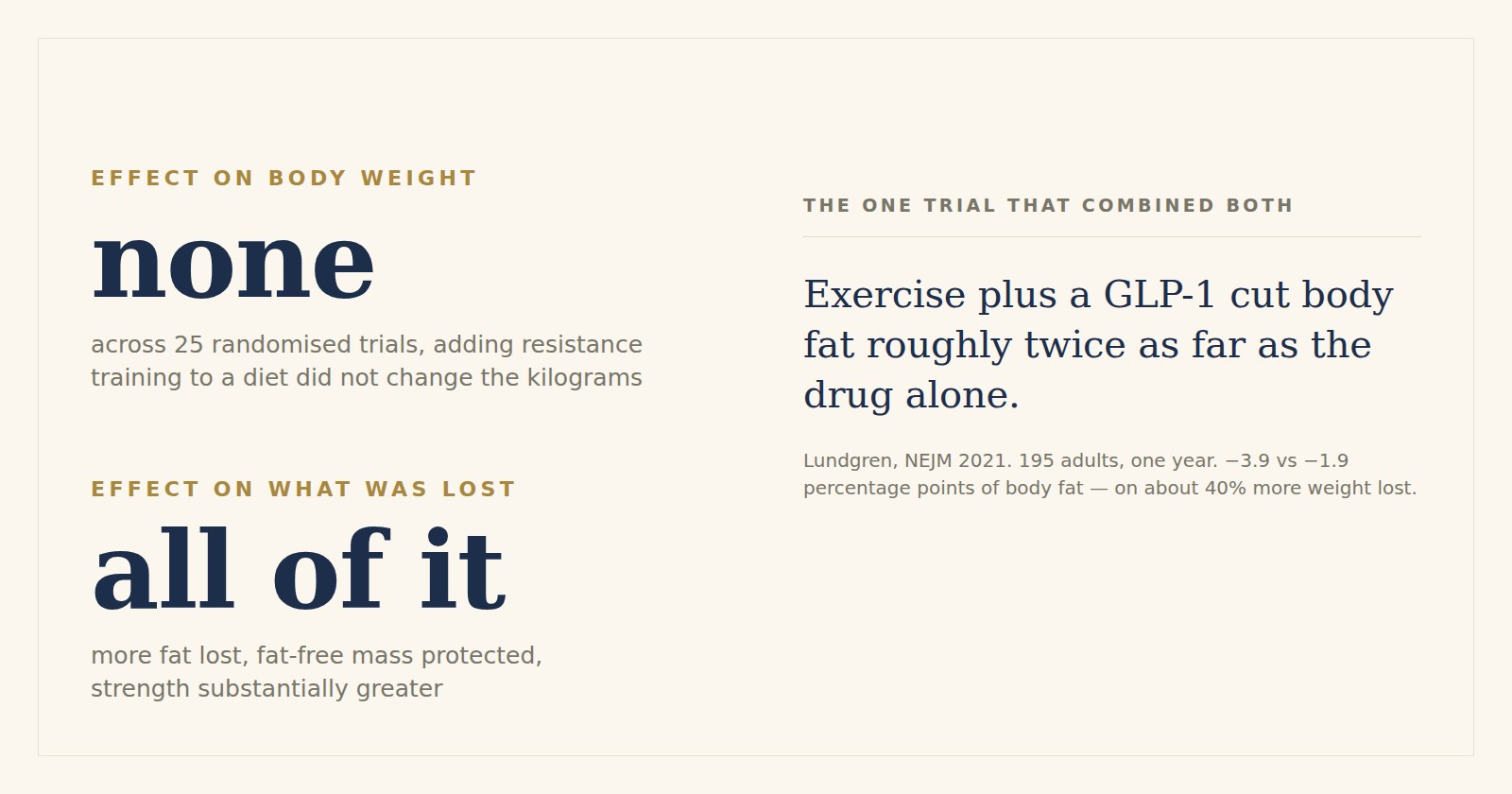
That is not a discouraging aside; it is the finding. A 2025 systematic review pooled 25 randomised trials of resistance exercise added to dietary weight loss and found no significant difference in body weight between the groups that trained and the groups that did not. What did differ was everything else: the training groups lost more fat, protected fat-free mass, and ended considerably stronger.
Training does not change how much you lose. It changes what the loss is made of.
That distinction matters more on a GLP-1 than almost anywhere else, because the scale is already moving quickly. The number on it will not tell you whether the weight leaving is fat or muscle, and it will not reward you for training. Plenty of people conclude the training is not working and stop. It was working; they were reading the wrong instrument.
The one trial that put exercise and a GLP-1 together
There is exactly one completed randomised trial that combined a GLP-1 medication with a structured exercise programme, and it is worth knowing in some detail.
Lundgren and colleagues, published in the New England Journal of Medicine in 2021. After an eight-week low-calorie diet, 195 adults were randomised to one of four arms for a year: exercise plus placebo, liraglutide plus usual activity, exercise plus liraglutide, or placebo plus usual activity.
The weight numbers are what most summaries quote: the combination arm lost the most. But the more interesting column is body-fat percentage. The combination group's body-fat percentage fell 1.9 percentage points further than the liraglutide-only group's (95% CI −3.3 to −0.5, P=0.009) — roughly double the change, on about 40% more weight lost.
Adding exercise did not simply produce more of the same result. It produced a different kind of result.
Three honest caveats about that trial
It is the best evidence available, and it is not a clean answer to the question this post asks.
- The drug was liraglutide, a daily GLP-1 that produces less weight loss than semaglutide or tirzepatide. Whether the same holds at the faster loss the newer agents cause is untested.
- The exercise was mostly aerobic. The prescription was 150 minutes a week of moderate activity, delivered as supervised sessions of interval cycling with 15 minutes of circuit training. That is not what most people mean by strength training.
- The design was weight-loss maintenance after a diet, not active dose escalation. The hardest weeks on a GLP-1 — the ones where eating and training are genuinely difficult — are not what was studied.
The trial that will answer the question properly is running now. LEAN-PREP randomises 232 people on semaglutide or tirzepatide to resistance exercise, protein, both or neither, with thigh muscle size measured by MRI. It is expected to report around 2027.
What resistance training does during weight loss generally
Outside the GLP-1 question, this is well studied, and the findings are consistent enough to be graded.
The 2025 review of 25 randomised trials found that adding resistance exercise to dietary weight loss protected fat-free mass (moderate certainty), increased fat loss (high certainty), and increased muscle strength substantially (low certainty, because strength was measured in many different ways). Body weight did not differ.
A 2026 review put numbers on the same effect: during weight loss, participants doing resistance training gained roughly 0.8–0.9 kg of fat-free mass, while those not exercising lost around 2.8–2.9 kg of it.
None of those trials involved a GLP-1 medication. This is extrapolation — the same kind we described in the piece on protein targets, and worth naming as such. But the mechanism is not drug-specific: muscle is retained when it is loaded and lost when it is not, whether the energy deficit comes from a diet or from a medication that makes you want to eat less.
Why the scale is the wrong instrument here
We wrote about the underlying problem in muscle loss on a GLP-1: a meaningful share of what comes off is fat-free mass. The scale cannot distinguish the two, and on these medications it is falling fast enough to be reassuring regardless.
This creates a specific trap. Someone starts training, sees no acceleration in weight loss — because there isn't any, and there was never going to be — and stops. They then lose weight faster per unit of effort, and a larger fraction of it is muscle.
Better instruments, in rough order of usefulness:
- What you can lift, and for how many repetitions. Free, weekly, and directly measures the thing you are trying to protect.
- How clothes fit at a given weight. Crude, but it tracks composition rather than mass.
- Grip strength or a sit-to-stand test, if your clinic measures them.
- Body composition scans, if available — though single measurements are noisy and the trend over months is what matters.
How much training, realistically
The honest answer is that the effective range is wide and the optimum is not established, which is good news: you do not have to find a perfect programme.
Trials showing benefit have used two to three sessions a week. A typical protocol starts at one to two sets of 8–15 repetitions and progresses toward three sets taken close to the point where form breaks down. Reviews of resistance training in older adults find benefit across a range of roughly two to five sessions weekly and a wide span of intensities.
Three things matter more than the details:
Load the large muscle groups. Legs, hips, back, chest. The muscle you are most at risk of losing is the muscle that carries you around.
Progress something over time. Weight, repetitions, or sets. Muscle responds to a demand that increases; it does not respond to a demand it has already met.
Choose what you will actually do twice a week for a year. A modest programme performed consistently beats an optimal one abandoned in March. This is the single most reliable predictor of whether any of the above happens.
Training while eating much less
This is the part specific to being on a GLP-1, and it is where most general fitness advice stops being useful.
You are training in an energy deficit, often a large one, with suppressed appetite and frequently with protein intake below any recommended target. That combination has predictable consequences, and knowing them in advance prevents people from misreading them.
- Expect strength to hold or rise slowly, not to climb. Maintaining strength while losing weight is a success, not a plateau.
- Expect recovery to take longer. Less fuel in means less capacity to repair. Two good sessions beat four rushed ones.
- Eat something before training if you can. Difficult on these medications; worth attempting anyway, and one of the more practical uses for liquid protein.
- Lightheadedness on standing is worth reporting, not pushing through. It is common when intake drops quickly and it is easy to check.
Weights or cardio?
Both, doing different jobs. Resistance training is the lever for preserving muscle; that is what the evidence above is about. Aerobic exercise carries the cardiovascular and metabolic benefits that have their own large literature, and the one trial combining exercise with a GLP-1 used a mostly aerobic programme.
If time is limited and the goal is protecting muscle, resistance training is the priority. If you enjoy the cardio and would otherwise do nothing, do the cardio — the comparison that matters is against not exercising, not against a theoretically better programme.
Why loading works at all
The mechanism is worth a paragraph, because it explains why nothing else on the market substitutes for it.
Muscle is metabolically expensive tissue, and the body does not maintain expensive tissue it is not using. In an energy deficit that logic sharpens: something has to give, and unloaded muscle is an obvious candidate. Contracting a muscle against meaningful resistance is the signal that says the tissue is still required. Nothing else sends that signal — not protein on its own, not a supplement, not the medication.
This is also why the effect is local rather than general. Training your legs protects your legs. A programme built entirely around upper-body machines will leave the muscle you need to get out of a chair unloaded, which is the muscle most worth having at seventy.
Who this matters most for
The stakes are not evenly distributed.
Muscle mass and strength decline with age anyway, and the decline accelerates after roughly the sixth decade. Someone in their sixties losing weight rapidly is subtracting from a smaller reserve, and is closer to the thresholds where losing muscle stops being cosmetic and starts affecting whether they can climb stairs or recover from a fall.
The same applies to anyone already carrying low muscle mass relative to their body size — a pattern that can hide entirely under a high body weight, which is precisely why it goes unnoticed. If either describes you, the training question is not an optional extra alongside the medication. It is part of the treatment, and it is worth raising before starting rather than after.
And when you stop
There is a second reason this matters, and it arrives later.
Most people who stop these medications regain a substantial share of the weight, which we covered in the honest answer about long-term use. Regained weight is not returned in the same proportions it left. Fat comes back readily; muscle does not come back unless it is trained back.
So a cycle of losing weight without training and then regaining it can leave someone at the same weight with less muscle than they started with. Doing this repeatedly is the mechanism behind a body composition that gets worse while the scale stays roughly still. Training during the loss is what breaks that cycle — and it is considerably easier to keep muscle than to rebuild it.
What we still do not know
- Whether resistance training preserves muscle during semaglutide- or tirzepatide-induced loss specifically. LEAN-PREP is the trial; it has not reported.
- Whether resistance training outperforms aerobic training in this population, or whether the combination beats either.
- How much of the benefit belongs to training and how much to the protein that usually accompanies it — which is why LEAN-PREP separates them.
- Whether preserved fat-free mass translates into preserved strength and function years later. Most trials are too short to say.
When to raise it with your prescriber
- New weakness in daily tasks — stairs, groceries, getting out of a low chair
- Lightheadedness, dizziness on standing, or unusual shortness of breath with effort
- You are unable to eat enough to train at all
- You have a cardiac history, or have been sedentary for a long time, and are about to start vigorous exercise
Where I land
Resistance training is one of two things with real evidence behind it for protecting muscle during weight loss, and it is the one that also makes you measurably stronger. It will not move the scale faster, and expecting it to is the most common reason people give it up.
Two sessions a week, loading the big muscle groups, progressing gradually, alongside enough protein. That is the whole prescription, and it has held up across 25 trials in people who were not on these medications and one trial in people who were.
Frequently asked questions
Will lifting weights help me lose more weight on a GLP-1?
No, and that is the point. A 2025 review of 25 randomised trials found no significant difference in body weight between people who added resistance exercise to dietary weight loss and those who did not. What differed was composition: the training groups lost more fat, protected fat-free mass, and gained strength. Training changes what you lose rather than how much.
Is there any trial of exercise combined with a GLP-1?
One completed trial. Lundgren and colleagues randomised 195 adults to exercise, liraglutide, both, or neither for a year after a low-calorie diet. The combination arm reduced body-fat percentage 1.9 percentage points more than liraglutide alone. The drug was liraglutide rather than semaglutide or tirzepatide, and the programme was mostly aerobic, so it is suggestive rather than definitive.
How many days a week do I need to train?
Trials showing benefit have generally used two to three sessions a week, and reviews find benefit across a range of roughly two to five. The optimum is not established. Consistency over months matters considerably more than the specific number.
Should I do cardio or weights?
Resistance training is the lever for preserving muscle, so if the goal is protecting muscle and time is limited, that is the priority. Aerobic exercise has its own substantial cardiovascular benefits, and the one trial combining exercise with a GLP-1 used a mostly aerobic programme. The meaningful comparison is against not exercising at all.
Why am I not getting stronger?
Holding your strength while losing weight is a normal and good outcome during an energy deficit, not a failed programme. Gains are slower when intake is low, and slower still when protein intake is below target, which is common on these medications.
Do I need a gym?
No. The trials used machines, free weights and circuits, but the requirement is loading the large muscle groups and increasing the demand over time. Bands, bodyweight progressions and household load can do that. The programme you will still be doing in six months is the one that works.
Before you go
If you are on one of these medications, the training question is worth raising at a visit rather than settling from a search result — particularly if you have a cardiac history, have been sedentary for a while, or are already struggling to eat enough to fuel what you are doing.
This article is for general education and is not medical advice for any individual. It doesn't establish a physician-patient relationship. Talk to a licensed clinician about your own situation.