

The short version
If you search this question you will find one number: 1.6 grams of protein per kilogram of body weight per day. It is quoted almost everywhere, usually without a source.
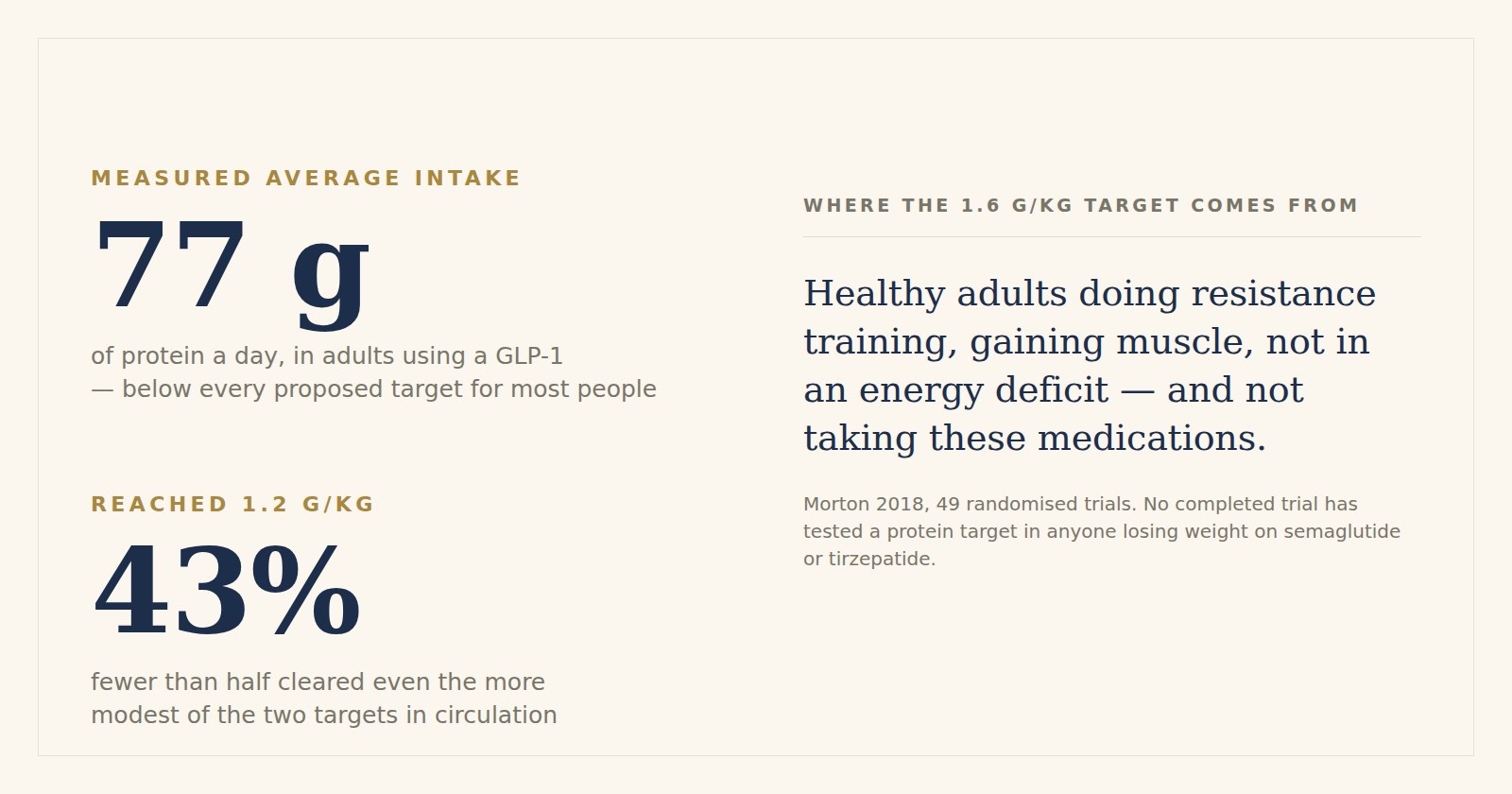
Here is where it comes from. In 2018 a meta-analysis pooled 49 randomised trials and 1,863 participants and found that protein intake above roughly 1.6 g/kg/day produced no further gains in fat-free mass. That is a real and well-conducted study. But read what it measured: gains in muscle, in healthy adults doing resistance training, who were not in an energy deficit and were not taking a GLP-1 medication.
No completed trial has tested protein targets in people losing weight on semaglutide or tirzepatide. The trial designed to answer that question - LEAN-PREP, 232 participants over six months - began enrolling in 2026, and its investigators state plainly that no studies have examined resistance exercise during weight loss on these drugs.
Meanwhile there is good data on what people taking these medications are actually eating, and it reframes the question entirely. In a 2025 study of 69 adults using GLP-1 medications, average protein intake was 77 grams a day, and fewer than half cleared even 1.2 g/kg - a substantially more modest target than the one the internet argues about.
The practical problem is not that people are missing an optimal number. It is that the medication makes eating enough of anything difficult, and protein is the thing most worth protecting.
Why protein is the lever
We covered the underlying issue in detail in muscle loss on a GLP-1: a meaningful share of the weight lost on these medications is fat-free mass, which includes muscle. That is true of most rapid weight loss and is not unique to these drugs — but loss is faster here, so the same proportion arrives in less time.
There are two levers with real evidence behind them: resistance training and protein intake. Most of what is marketed at this problem is either unstudied or is one of those two wearing a different label.
Protein earns its place for three reasons. It is the macronutrient directly required to build and maintain muscle tissue. It is the most satiating per calorie, which matters less while appetite is suppressed but matters a great deal when appetite returns. And it is the nutrient most easily crowded out when total intake falls, because the foods people manage when they can only eat a little are rarely the protein-dense ones.
Where the numbers actually come from
This is the part that usually gets skipped, and it is the part that tells you how much confidence any given number deserves.
1.6 g/kg - Morton and colleagues, 2018. Forty-nine randomised trials, 1,863 participants. The population was healthy adults doing resistance training and the outcome was gaining fat-free mass, not preserving it during weight loss. The 1.6 figure marks the point past which more protein added nothing further. It was never a recommendation for people on a GLP-1. The LEAN-PREP investigators borrowed it as a reasonable dose for their protein arm precisely because there was nothing better to borrow.
1.0–1.2 g/kg - the ESPEN Expert Group's 2014 recommendation for healthy older adults, rising to 1.2–1.5 g/kg for those who are ill. This is the most relevant existing guidance for preservation rather than gain, and it is aimed at ageing, not at pharmacological weight loss.
80–120 g/day - a 2026 proposal for GLP-1 patients drawn explicitly from bariatric surgery protocols. The authors are candid about why: “Presently, there is a lack of prospective studies to determine optimal protein amounts.”
So the honest answer to “how much protein” is: somewhere between about 1.0 and 1.6 g/kg, with the lower end supported by ageing research, the upper end borrowed from resistance-training research, and the middle occupied by an extrapolation from bariatric surgery. None of it has been tested in this population yet.
That is not a reason to ignore the guidance. Extrapolated evidence is still evidence, and the direction of every source agrees. It is a reason to be suspicious of anyone quoting a single decimal-place figure as though it were settled.
The finding that actually matters
While the field argues about the target, here is what was measured in people taking these drugs.
Sixty-nine adults, on a GLP-1 medication for at least a month. Average daily energy intake: 1,748 calories. Average protein: 77 grams, about 18.5% of calories. Only 43% reached 1.2 g/kg.
Protein was not the only shortfall. The same study found intakes below the dietary reference for fibre, calcium, iron, magnesium, potassium, choline, and vitamins A, C, D and E.
Two things follow.
First, the gap is large and it is not subtle. For an adult weighing 90 kg, 1.2 g/kg is 108 grams. The measured average was 77. That is not fine-tuning; it is roughly a third short of a conservative target.
Second, and most advice misses this, protein has to become a bigger share of a smaller total. At 1,748 calories, 77 grams of protein is about 18% of intake. Getting the same person to 108 grams means protein rises to roughly a quarter of calories. You cannot reach the target by eating the way you ate before in smaller portions. The composition has to change, not only the volume.
One more ambiguity nobody mentions
Every target above is expressed per kilogram of body weight - but the guidelines disagree about which body weight. Some index to actual weight, some to ideal weight, some to an adjusted figure in between. At higher body weights that choice moves the target by thirty or forty grams a day, which is a larger difference than the gap between the 1.2 and 1.6 recommendations people argue about.
At 110 kg, 1.6 g/kg of actual body weight works out to 176 grams - more than 40% of a 1,700-calorie intake, which is not realistically achievable while appetite is suppressed. That is a good sign the number is being applied outside the population it came from.
This is a question for the person who ordered your labs, not for a calculator.
What this looks like in practice
The evidence thins considerably from here. What follows is clinical convention, and I would rather label it that way than dress it up.
Put protein first in the meal. When early satiety is the limiting factor, the order things are eaten in decides what actually gets eaten. This is standard practice after bariatric surgery and it transfers reasonably.
Front-load the day. Appetite suppression is often strongest in the day or two after a dose, and many people find mornings easier than evenings. Convention, not trial data.
Use liquid protein when solids are difficult. A shake asks less of your appetite than the equivalent chicken breast. Most useful during titration weeks and after dose increases - the same weeks when nausea tends to concentrate.
Spread it across meals rather than one large serving. There is a long-running debate about whether a per-meal threshold exists. The ESPEN group reviewed the question and declined to set one, noting it is unresolved. Spreading intake is sensible and harmless; the precise per-meal gram target you may have read is not established.
Pair it with resistance training. Protein without a stimulus to use it does less. This is the most consistent finding across the whole literature, and it is why LEAN-PREP is testing protein and training as separate arms as well as together — because how much of the benefit belongs to each is genuinely unknown.
What we do not know
Being specific about the gaps is more useful than pretending they are not there.
- Whether any protein target improves outcomes in people taking these medications. LEAN-PREP is the trial; it has not reported.
- Whether protein alone, without resistance training, preserves meaningful muscle during this kind of rapid loss.
- Whether a per-meal threshold exists, and if so what it is.
- Whether preserved fat-free mass translates into preserved strength and function — which is what actually matters to a person, and which most body-composition studies do not measure.
Is a higher protein intake safe?
For people without kidney disease, the common concern is not well supported. A systematic review and meta-analysis found that changes in kidney function did not differ between healthy adults eating higher-protein diets and those eating lower- or normal-protein diets, and a 2026 review reached the same conclusion in adults without chronic kidney disease.
The qualifier matters: that evidence concerns people with normal kidney function. It does not extend to established chronic kidney disease, where protein intake is a real clinical question that has to be individualised.
Which is one of several reasons bloodwork comes before treatment rather than after it. Kidney function is on the baseline panel. If it is abnormal, the protein conversation changes - and so does the medication conversation.
When to raise it with your prescriber
- You are consistently unable to eat, not merely eating less
- You are losing weight faster than roughly 1–2% of body weight per week over a sustained period
- You notice new weakness - stairs, carrying groceries, getting out of a low chair
- You have known kidney disease and are being told to increase protein by someone who has not seen your labs
None of these is an emergency. All of them are reasons to adjust something, and the adjustment is usually easier the earlier it happens.
Where I land
The number matters less than the direction, and the direction is unambiguous: almost everyone taking these medications is eating less protein than any of the proposed targets, and the shortfall is large enough that arguing about 1.2 versus 1.6 is beside the point.
Aim for the range. Anchor it to your weight rather than to a figure you read. Get it alongside resistance training rather than instead of it. And treat anyone who quotes you a precise number without mentioning that the trial is still running as someone who has not read the trial.
Frequently asked questions
How much protein should I eat on a GLP-1?
The proposed targets range from about 1.0 to 1.6 grams per kilogram of body weight per day, but none has been tested in people taking these medications. The lower end comes from research on healthy older adults, the upper end from resistance-training research in people who were not dieting. What is measurable is that average intake among people on these drugs is about 77 grams a day, which is below every proposed target for most adults. Closing that gap matters more than choosing between 1.2 and 1.6.
Where does the 1.6 g/kg figure come from?
A 2018 meta-analysis of 49 randomised trials and 1,863 participants found that protein above roughly 1.6 g/kg per day produced no further gains in fat-free mass. The participants were healthy adults doing resistance training who were not in an energy deficit and were not taking a GLP-1 medication. It is a sound study applied outside the population it studied.
Is there any trial of protein in people on semaglutide or tirzepatide?
One is running. LEAN-PREP randomises 232 participants over six months to resistance exercise, protein, both, or neither, with quadriceps muscle size measured by MRI. It began enrolling in 2026 and is expected to report around 2027. Until then, every protein target for this population is extrapolated from other groups.
Do I need protein powder?
No. Protein from food and protein from a shake are both protein. Liquid protein is simply easier to get down when early satiety or nausea is the limiting factor, which is why it comes up during titration weeks. Whether you use one is a practical question, not a clinical one.
Will a high-protein diet damage my kidneys?
In people with normal kidney function, systematic reviews have not found a difference in kidney function between higher- and lower-protein diets. That evidence does not extend to established chronic kidney disease, where protein intake needs to be individualised. Kidney function is part of baseline bloodwork for this reason.
Does protein help if I am not doing any resistance training?
Probably less. Protein supplies the material; training supplies the signal to use it. The relationship between the two has not been separated in anyone taking these medications, which is exactly what LEAN-PREP is designed to test.
Before you go
If you are on one of these medications, or considering one, the protein question is worth raising at your visit rather than resolving from a search result — because the right target depends on your weight, your kidney function and what you are able to eat, and because the honest state of the evidence is that nobody has tested this in people like you yet.
This article is for general education and is not medical advice for any individual. It doesn't establish a physician-patient relationship. Talk to a licensed clinician about your own situation.