

Last reviewed: September 2026
The short version
Two questions arrive constantly, and they are really one situation: the dose is not going in when it was supposed to. Either you forgot, or you are too unwell to take it.
Three things are worth knowing before the situation arrives.
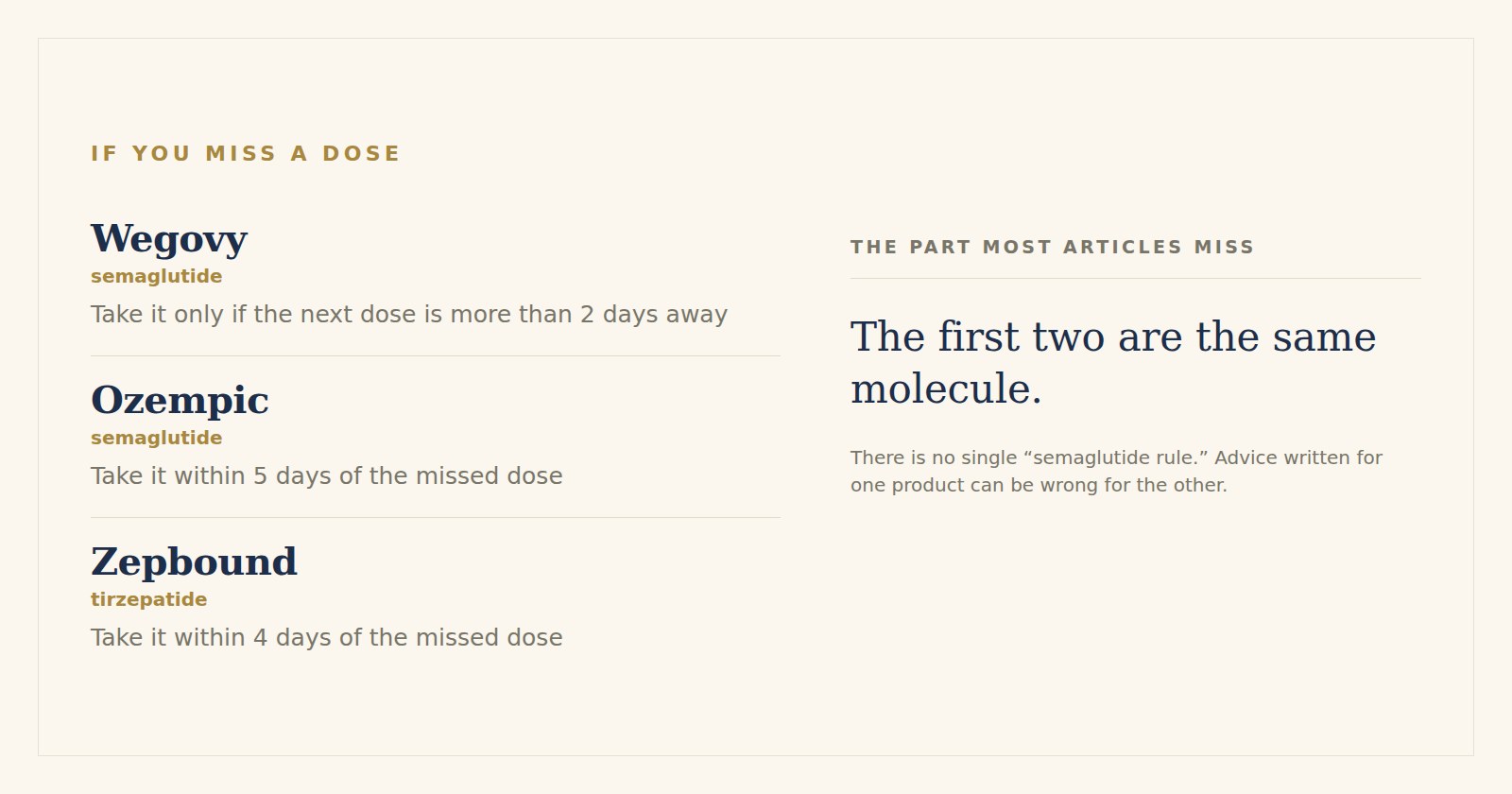
There are three different missed-dose rules, and two of them are the same drug. Ozempic® and Wegovy® are both semaglutide, and their labels give different instructions for a missed dose. Zepbound® gives a third. Almost every article answering this question offers a single rule for all of them, which means most people reading about a missed dose are reading the wrong instruction.
The sick-day question is not really about the dose. It is about dehydration. Both labels carry a warning about acute kidney injury, and both tie it specifically to vomiting, diarrhoea and the fluid loss they cause. Whether to take an injection while unwell is downstream of a bigger question: are you managing to keep fluids in?
There are no official sick-day rules for these medications. For diabetes drugs, this is a mature, formalised field — the NHS publishes patient leaflets telling people exactly which medicines to pause when they are vomiting, and there is published consensus work on sick-day medication guidance in diabetes, kidney and cardiovascular disease. Nothing equivalent exists for GLP-1 medications prescribed for weight. That gap is why the internet is full of confident, contradictory answers.
The missed-dose rules, verbatim
These are quoted directly from the FDA prescribing information, because paraphrasing them is how the confusion starts.
Read them together and the differences are structural, not cosmetic.
Wegovy asks you to look forward. If the next scheduled dose is more than two days away, the missed dose can be taken as soon as possible. If it is less than two days away, that dose is skipped. The question is how much room is left before the next one.
Ozempic and Zepbound ask you to look backward. Ozempic's window is five days after the missed dose; Zepbound's is four days, ninety-six hours. After that the dose is skipped and the next one happens on the normal day. The question is how long it has been.
The part worth sitting with is that Ozempic and Wegovy are the same molecule. Semaglutide does not behave differently depending on the indication printed on the box, but the instructions do, and they were written by the same manufacturer. Whatever the reason, the practical consequence is that "the semaglutide rule" is not a thing. There is a Wegovy rule and an Ozempic rule.
Someone who remembers on Thursday that they missed Monday, with the next dose due Monday, is inside the window on Ozempic, inside it on Zepbound, and outside it on Wegovy. Same calendar, three answers. This is exactly the detail a general article gets wrong and a label gets right.
Changing which day you inject
Three products, three answers again.
Ozempic states the day of weekly administration can be changed if necessary as long as the time between two doses is at least two days — more than 48 hours. Zepbound requires at least three days, 72 hours. The Wegovy label does not state a minimum interval for changing the day at all; it says the time of day and the injection site can be changed without any dosage modification.
If you want to move your injection day, that is worth raising rather than assuming the rules match. They do not.
If more than one dose has been missed
The semaglutide label addresses this directly: if two or more consecutive doses are missed, dosing can be resumed as scheduled, or the medication can be reinitiated following the dose escalation schedule. Note that both options are offered — which one applies is a clinical judgement about how long the gap was and how well you tolerated the dose before it.
That is a prescriber decision, and it is a real one. Restarting at a dose your body has lost tolerance for is a common way to reproduce the nausea of the early weeks after months of feeling fine.
What a missed dose actually costs
Less than people fear, usually.
These are weekly medications with long durations of action, and one missed dose in an otherwise steady course is not a crisis. Appetite may return noticeably toward the end of the gap. Weight may tick up. Neither undoes the treatment.
The thing worth protecting is not the individual dose - it is tolerability. The whole reason these drugs are escalated slowly is that the gut adapts to them over weeks. A long enough gap can undo some of that adaptation, which is why restarting after a break is a conversation rather than a default.
Being unwell: the question underneath the question
Here is what the labels actually warn about.
The semaglutide label reports postmarketing cases of acute kidney injury, in some instances requiring dialysis, and states that the majority occurred in people who had gastrointestinal adverse reactions leading to dehydration — nausea, vomiting or diarrhoea. The tirzepatide label makes the same connection: acute kidney injury that can result from dehydration due to gastrointestinal adverse reactions. The semaglutide label also directs prescribers to monitor kidney function in patients reporting reactions that could lead to volume depletion, particularly during initiation and dose escalation.
So the mechanism is not mysterious. A medication that reduces how much you want to eat and drink, plus an illness that is taking fluid out of you, plus a week where you cannot face a glass of water, is a combination that can affect the kidneys. The dose question matters because of that, not on its own.
Which is one of the reasons kidney function is on the panel before treatment starts - there is a baseline to compare against if something changes.
The figure above is not a decision tool and is not a substitute for calling. It is the set of categories a prescriber is thinking in when you describe what is happening, and knowing them makes that conversation faster.
Surgery and procedures
This one has actual guidance, which makes it the exception.
A multi-society clinical practice guidance published in 2024 - anaesthesiologists together with gastroenterology and obesity medicine groups - addressed the safe use of GLP-1 medications around procedures. The direction of travel has been away from blanket instructions to stop. The American Gastroenterological Association's summary of the position is that most patients can continue these medications before surgery, with decisions individualised rather than applied as a rule.
The practical point for a patient is narrower: tell the person doing the procedure that you take one of these medications, well before the day. Do not decide unilaterally to stop, and do not assume the scheduler has passed it on.
Why no one has written sick-day rules for this
It is worth naming the gap rather than papering over it.
In diabetes care, sick-day guidance is a mature genre. Patients on metformin or an SGLT2 inhibitor are given written instructions about which medicines to pause during an illness with vomiting or diarrhoea, and there is published consensus work behind that guidance. It exists because the risks - dehydration, kidney injury, ketoacidosis - are well characterised and the population is large.
GLP-1 medications prescribed for weight management have the first ingredient and not yet the second. The label warnings are clear about the dehydration pathway. No professional body has turned them into a sick-day protocol for this indication.
In the absence of that, the honest answer is the unsatisfying one: the labels tell you what the risk is, they do not tell you what to do on a Tuesday when you have a stomach bug, and the person who can answer that is the one who prescribed it and knows your kidney function.
Practical things that make this easier
- Know which of the two rules applies to you before you need it. They are different, and looking it up while unwell is worse than knowing.
- Have a way to reach your prescriber that is not a phone tree on a Saturday. If you do not know what that route is, find out while nothing is wrong.
- Track fluids, not just doses, during any illness. It is the variable the labels actually care about.
- Do not double up. Neither label supports taking two doses close together to catch up, and the escalation schedules exist precisely because dose increases are what the gut struggles with.
- Write down when you injected. Most missed-dose confusion is really uncertainty about whether a dose was taken at all.
When to contact your prescriber rather than wait
- Vomiting or diarrhoea that has gone on more than about a day, or any inability to keep fluids down
- Signs of dehydration — markedly reduced urine, dizziness on standing, confusion
- Severe or persistent abdominal pain, particularly if it radiates to the back or comes with vomiting
- Two or more consecutive doses missed, before restarting
- Any planned procedure or surgery, well in advance
- A new medication started by anyone else while you are on this one
Where I land
Missing a dose is common, rarely serious, and governed by a rule that is printed on your label and differs between the two medications. Learn the one that applies to your product, not to your molecule.
Being ill on one of these is the more important half of the question, and the thing being managed is fluid, not the injection. If you are keeping fluids down and it is short-lived, this is usually a small problem. If you are not, it stops being about the dose.
Frequently asked questions
What should I do if I miss a dose of semaglutide?
It depends which product you are prescribed, because the two semaglutide labels differ. Wegovy instructs that if the next scheduled dose is more than two days away the missed dose can be administered as soon as possible, and if it is less than two days away the missed dose is not administered. Ozempic instructs that a missed dose can be administered as soon as possible within five days after the missed dose. Same molecule, two rules. Your prescriber's instructions for your situation take precedence over any general summary.
What should I do if I miss a dose of tirzepatide?
The Zepbound label instructs that a missed dose can be administered as soon as possible within four days, or 96 hours, after the missed dose. If more than four days have passed, the missed dose is skipped and the next dose is administered on the regularly scheduled day.
Can I change the day of the week I inject?
The three labels give three answers. Ozempic states the day can be changed as long as at least two days, more than 48 hours, separate the two doses. Zepbound requires at least three days, 72 hours. The Wegovy label does not specify a minimum interval for a day change at all, stating only that the time of day and the injection site can be changed without a dosage modification. Worth confirming with your prescriber rather than assuming the products work the same way.
Should I skip my dose if I have a stomach bug?
That is a decision for the person who prescribed it, and it depends on how unwell you are, how long it has lasted and what your kidney function looks like. What the labels establish is why it matters: both carry warnings about acute kidney injury linked to dehydration from vomiting and diarrhoea. The general question to answer first is whether you are keeping fluids down.
Do I need to stop before surgery?
Not necessarily. Multi-society guidance published in 2024 moved away from blanket instructions to stop, and the American Gastroenterological Association has summarised the position as most patients being able to continue before surgery, with decisions made individually. The important step is telling the team performing the procedure that you take the medication, well before the day.
What happens if I have missed several weeks?
The semaglutide label states that if two or more consecutive doses are missed, dosing may be resumed as scheduled or the medication may be reinitiated following the dose escalation schedule. Which applies is a clinical decision, and it matters mostly for tolerability: restarting at a dose you have lost adaptation to is a common way to bring back the nausea of the first few weeks.
Before you go
Nothing here is instruction for your situation, and it deliberately stops short of telling you whether to take a particular injection on a particular day. That answer depends on your labs, your history and how unwell you actually are. What this is for is knowing which questions matter, so the conversation with your prescriber is a short one.
Ozempic® and Wegovy® are registered trademarks of Novo Nordisk. Mounjaro® and Zepbound® are registered trademarks of Eli Lilly and Company. Billie Jean Health is not affiliated with, endorsed by, or sponsored by either company.
This article is for general education and is not medical advice for any individual. It doesn't establish a physician-patient relationship. Talk to a licensed clinician about your own situation.