

Nausea is the single most common reason people stop these medications, and a large share of the time it didn't have to end that way.
I say that carefully, because there is a version of this article that reads as push through it, and that's not what I mean. Some people should stop. Some should change drugs. Some are having a problem that isn't the medication at all and needs looking at. What I mean is narrower: most nausea on a GLP-1 arrives at a predictable time, for an understandable reason, and responds to adjustments that are available to anyone whose prescriber is paying attention.
So here's the whole picture — the numbers, the mechanism, what helps and how well we actually know that, and the symptoms that mean call today rather than tough it out.
How common is it, really
These are the figures from the FDA-approved product labels. They're the most reliable numbers available because they come from large randomized trials with placebo groups.
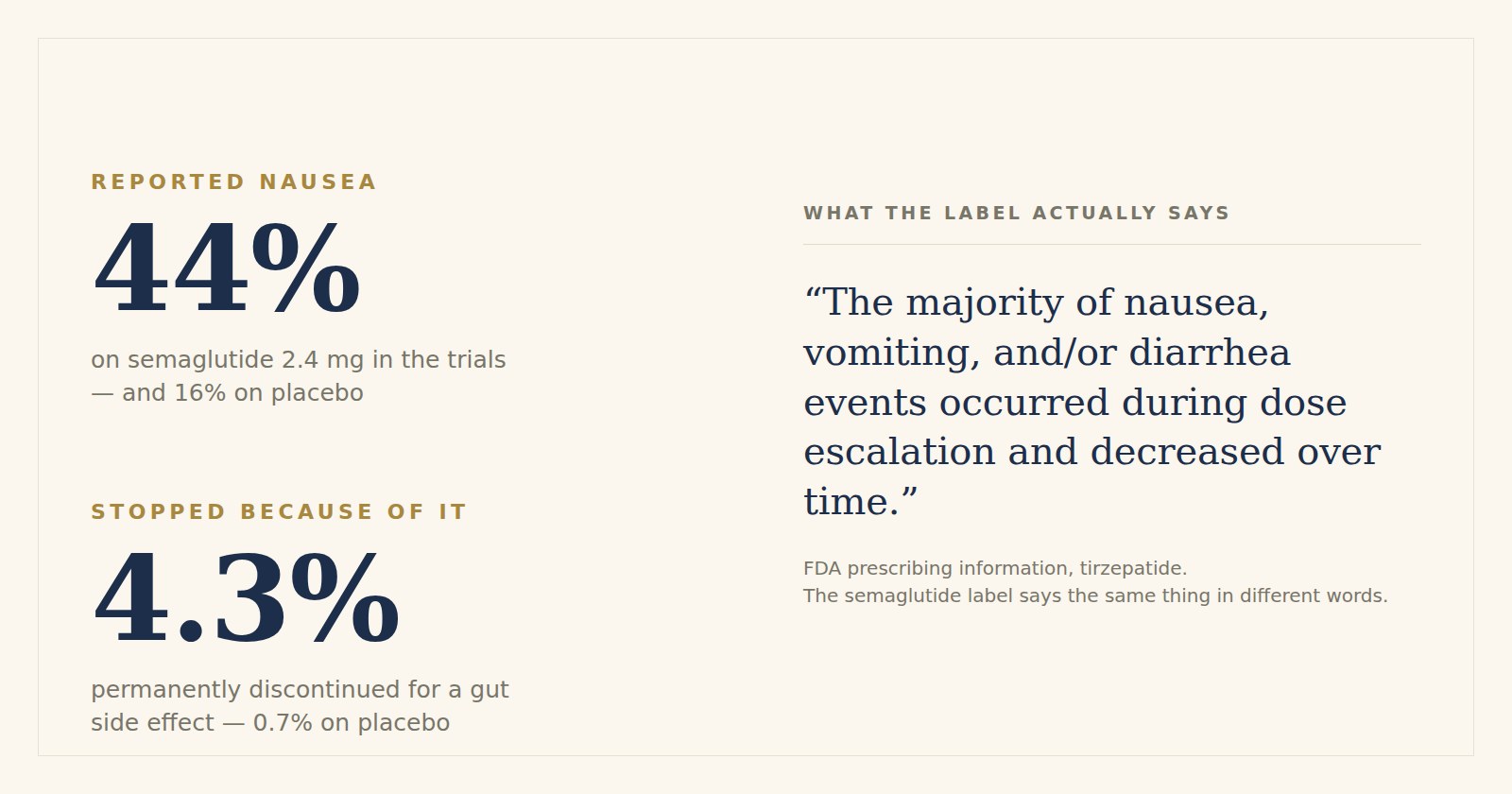
I want you to notice the placebo columns. A meaningful number of people on a saline injection reported nausea too — 16% in the semaglutide trials. That doesn't make anyone's symptoms imaginary. It means some of what gets attributed to the drug is the ordinary background of being a human with a digestive system, and it's why the placebo-subtracted difference is the honest way to read a side effect table.
Two things the label says that matter more than the percentages
First: it clusters during dose escalation. The tirzepatide label puts it plainly — the majority of nausea, vomiting and diarrhea events occurred during dose escalation and decreased over time. The semaglutide label says the same thing in different words. This is not a side effect that typically builds; it's one that typically front-loads, around starting and around each step up, and then settles as you hold at a dose.
Second: very few people actually quit over it. Permanent discontinuation because of a gastrointestinal side effect happened in 4.3% of people on semaglutide 2.4 mg, versus 0.7% on placebo. For tirzepatide it ran between 1.9% and 4.3% depending on dose, against 0.5% on placebo.
Sit with the gap between those two sets of numbers. Something like 44% of people on semaglutide reported nausea. About 4% stopped because of it. The overwhelming majority of nausea on these drugs is real, unpleasant, and temporary.
That's the most useful thing I can tell you at week two, when it feels like it will never end.
Why it happens
Two mechanisms at once, and both of them are the drug doing its job.
Centrally, GLP-1 receptors in the brainstem and hypothalamus are part of the same circuitry that governs appetite and nausea. You cannot currently turn down appetite through that pathway without brushing against the nausea signal next to it.
Peripherally, these medications slow gastric emptying. Food sits in the stomach longer, which is part of why you feel full sooner and stay full — and also why a large or fatty meal can sit there like a stone and make you queasy.
I point this out because patients often ask whether nausea means the dose is "too strong" or the drug is "not right for me." Usually it means neither. It means the medication is doing the thing you're taking it to do, at a moment when your body hasn't adjusted yet.
What actually helps — and how well we know it
Here's where I have to be straight with you about something the internet will not tell you.
Almost none of the standard nausea advice has been tested in a randomized trial in people taking GLP-1 medications. The eating strategies, the meal timing, the food avoidances — these come from clinical experience and expert consensus documents, not from studies that randomized people to do them or not. A 2026 review of GI effects with these drugs lists essentially the whole management toolkit and characterizes all of it as consensus recommendation.
That doesn't make the advice wrong. Consensus is what medicine uses when trials don't exist, and this advice is cheap, harmless and consistent with the mechanism. But you deserve to know which parts rest on evidence and which rest on judgment, because plenty of sites present all of it with the same confident tone.
What has actual trial backing: the titration schedule itself. Every one of these drugs is approved with a stepped dose-escalation schedule specifically because starting low and going up slowly reduces GI effects. That's built into the label and it's the strongest lever there is.
What is clinical convention, and what I recommend anyway:
- Stop eating at the first sign of fullness. Not when the plate is empty — at the first signal. This is the single change that helps most of my patients, and it's the hardest one, because most of us learned to eat to a plate rather than to a signal.
- Smaller meals, more often, rather than two or three large ones.
- Go easy on fat and on very spicy food, especially in the days right after a dose increase. Fat slows gastric emptying further, on top of a drug that's already slowing it.
- Drink through the day rather than with meals, so you're not adding volume to a stomach that's already emptying slowly.
- Keep fluids and fiber up. Constipation and nausea travel together more often than people expect, and treating the constipation sometimes resolves the queasiness.
- Notice your timing. Some people do better injecting on a particular day of the week so the worst 48 hours land where their life can absorb it.
What belongs to your prescriber, not to a blog:
- Slowing the titration, or holding at your current dose. Entirely legitimate, frequently the right answer, and it does not mean the treatment failed. There is no prize for reaching the top dose on schedule.
- Reducing the dose.
- Short-term anti-nausea medication. These are prescription decisions with real interactions and real cautions, and the right choice depends on your other medications and your heart, kidneys and history. Ask; don't self-source.
- Switching agents. Tolerability differs between these drugs, and someone who can't tolerate one sometimes does fine on another.
What not to do
- Don't push through severe symptoms in silence. The failure mode I see most is someone white-knuckling it for six weeks, getting dehydrated, and then quitting entirely — when a dose adjustment in week two would have fixed it.
- Don't stop without telling anyone. If you're done, be done — but let your prescriber know, because there are things to discuss about what comes next.
- Don't double up or jump ahead to "catch up" after a missed dose. Escalating faster than the schedule is how people end up in the emergency department, and I say that as someone who spent fifteen years working in one.
- Don't buy anti-nausea medication from wherever the drug came from, if the drug came from somewhere other than a pharmacy with a name.
The symptoms that mean call, not cope
Most nausea on these medications is unpleasant but ordinary. Some of it isn't, and the difference matters.
- Severe abdominal pain, especially in the upper abdomen and radiating to the back, with persistent vomiting. This is the pattern that raises the question of pancreatitis. It is an evaluation-today symptom, not a wait-and-see one.
- Vomiting you can't keep any fluids down through, or the signs of dehydration that follow — dizziness on standing, very dark urine, not urinating.
- Pain in the right upper abdomen, particularly after fatty meals, which raises the gallbladder question.
- Nausea that starts for the first time on a dose you have been stable on for months. That is not the typical pattern, and something else deserves to be considered.
- Any severe symptom you weren't warned about.
None of these mean you did anything wrong. They mean the situation needs a physician looking at it rather than a blog post.
The one thing almost nobody tells you: surgery and procedures
If you are having any procedure that involves sedation or general anesthesia — surgery, a colonoscopy, dental work under sedation — tell the person doing it that you are on a GLP-1 medication. Slowed gastric emptying means the stomach may not be empty even after a standard fast, which matters for aspiration risk.
The current multi-society guidance, issued in October 2024 by the anesthesiologists' society together with the gastroenterology and bariatric surgery societies, is more reassuring than the earlier advice: most patients should continue their GLP-1 medication before elective surgery rather than stopping it. For patients at highest risk — those still in the escalation phase, those with active GI symptoms, those on higher doses, and those with other conditions affecting stomach motility — the guidance suggests a liquid-only diet for the 24 hours beforehand, along with other risk-reduction measures the anesthesia team can take.
The decision belongs to your surgeon and anesthesiologist. Your job is to make sure they know.
A note on choosing between the drugs
People sometimes want to pick their medication off a side effect table, and I'd gently steer you away from that.
The label numbers above come from different trials, in different populations, with different titration schedules — they are not a head-to-head comparison and shouldn't be read as one. A 2025 network meta-analysis pooling 39 trials and more than 33,000 people did compare relative risks across agents, but relative risk depends on what each trial's placebo group did, and the rankings it produced don't line up neatly with the raw label percentages.
Which is the honest answer: there is no clean tolerability winner, and your individual response is not predictable from group data. Side effect profile is one input into that choice, alongside your history, your other conditions, and what you're actually able to get and afford.
Where I land
Nausea on these medications is common, mostly temporary, mechanistically expected, and usually manageable — and it is also the thing most likely to end treatment that was otherwise working.
The variable that matters most isn't which drug you're on or what you eat. It's whether someone is paying attention while you go through it, and whether you tell them early enough for an adjustment to help. Week two is a much better time to have that conversation than week eight.
My patients hear a version of this constantly: the message about feeling terrible is never an inconvenience. It's the whole point of having a physician rather than a prescription.
Frequently asked questions
How long does GLP-1 nausea last?
For most people it clusters around starting the medication and around each dose increase, then settles once you hold at a dose. Both the semaglutide and tirzepatide labels report that GI events occurred mostly during dose escalation and decreased over time. If nausea is persistent at a stable dose, or starts fresh months in, that's worth evaluating rather than waiting out.
Does the nausea mean it's working?
No. Nausea and weight loss both come from the same drug acting on the same systems, but the amount of nausea you experience does not tell you how well the medication is working for you. People with minimal side effects lose weight, and people with significant nausea sometimes don't.
What foods help with GLP-1 nausea?
The usual advice is smaller and more frequent meals, stopping at the first sign of fullness, and easing off high-fat and very spicy foods around a dose increase. Worth knowing: this advice comes from clinical experience and consensus recommendations, not from randomized trials in people on these medications. It's low-risk and mechanistically sensible, which is why I recommend it, but it hasn't been formally tested.
Should I lower my dose if I feel sick?
That's a conversation with your prescriber, not a decision to make alone — but holding at your current dose or stepping back down is a normal, legitimate adjustment, not a failure. There's no prize for reaching the highest dose fastest.
Can I take anti-nausea medication with a GLP-1?
Sometimes, short-term, and it's a prescribing decision. The options have real interactions and cautions that depend on your other medications and your medical history, which is why the specific choice belongs with your physician rather than a website.
Do I need to stop my GLP-1 before surgery?
Usually not. The October 2024 multi-society guidance recommends that most patients continue GLP-1 medications before elective surgery, with extra precautions — such as a 24-hour liquid diet — for those at highest risk of a full stomach. What matters most is that your surgeon and anesthesiologist know you're taking it.
Before you go
If you're two weeks in and miserable and quietly wondering whether this was a mistake — that's an extremely common place to be, and it's usually the worst of it rather than the shape of things to come.
Tell whoever prescribed it. Early. There are more adjustments available than most people realize, and almost all of them work better before you've spent a month being unable to eat.
If you're in Texas and want that kind of attention on your treatment rather than a prescription and a portal, that's what an initial visit is for.
Ozempic® and Wegovy® are registered trademarks of Novo Nordisk. Mounjaro® and Zepbound® are registered trademarks of Eli Lilly and Company. Billie Jean Health is not affiliated with, endorsed by, or sponsored by either company.
This article is for general education and is not medical advice for any individual. It doesn't establish a physician-patient relationship. Talk to a licensed clinician about your own situation.