

If you've been told your labs are "normal" but you feel anything but, I want you to know that you are not imagining it, and you are not the first woman to sit across from a physician and be told that everything looks fine.
I spent about fifteen years in emergency medicine before I founded Billie Jean Health, and one of the things emergency medicine teaches you is how often the real story is in what the patient is telling you rather than in the number on the screen. That lesson turns out to matter enormously in women's hormone health, because for the most common cause of hormone symptoms in midlife — the menopausal transition — there is no single blood test that gives you a clean answer.
So let me give you the short version up front, and then we'll go deeper.
The short answer
Most of what gets called "hormone imbalance" in women between roughly 38 and 58 is the menopausal transition: the years-long, deeply uneven decline in ovarian hormone production that ends in menopause. It produces a much wider range of symptoms than most people expect — not just hot flashes, but sleep disruption, mood changes, brain fog, joint aches, vaginal and urinary changes, and shifts in body composition.
And here is the part that surprises people: for most women, this is a clinical diagnosis, not a laboratory one. The U.S. Office on Women's Health states plainly that hormone levels "go up and down in an unpredictable way during the transition to menopause," which is why routine hormone testing isn't recommended for most women in this stage. Your menstrual pattern and your symptoms are usually more informative than a single FSH level drawn on a random Tuesday.
That does not mean testing is useless. It means testing has a specific job — mostly ruling out the other conditions that look exactly like this. More on that below.
The timeline: this starts earlier and lasts longer than most women are told
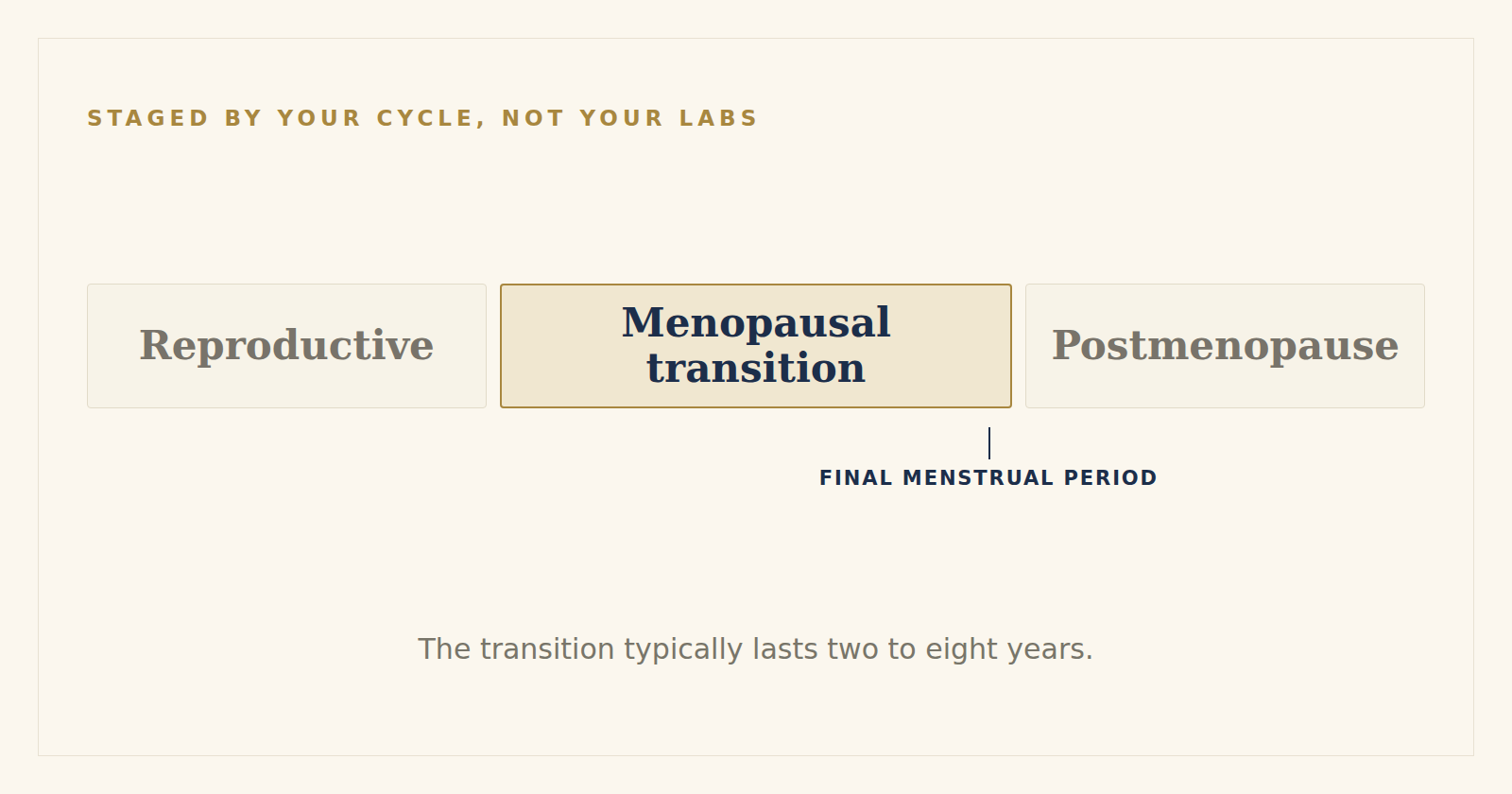
The average age of menopause in the United States is 52, and the transition leading up to it typically begins in a woman's mid-to-late 40s. But "typically" is doing a lot of work in that sentence. The Office on Women's Health notes the transition can last anywhere from two to eight years, and some women begin noticing changes in their late 30s.
The framework clinicians use is called STRAW+10 — the Stages of Reproductive Aging Workshop criteria, updated in 2012 and now the standard staging system in the field. It's worth knowing because it's anchored on your cycle, not your labs:
- Late reproductive stage: cycles are still regular, but subtly changing — sometimes shorter, sometimes heavier or lighter. Fertility is declining. Many women feel the first symptoms here and are told they're too young.
- Early menopausal transition: persistent variability of seven days or more in cycle length, or a skipped period. This is where "perimenopause" usually becomes obvious.
- Late menopausal transition: intervals of 60 days or more without a period. This stage is often where vasomotor symptoms peak.
- Final menstrual period: identified only in hindsight, after twelve consecutive months without bleeding.
- Early and late postmenopause: the years that follow, during which some symptoms settle and others — particularly the genitourinary ones — tend to continue or worsen without treatment.
On duration: the Study of Women's Health Across the Nation (SWAN), one of the largest and longest-running studies of midlife women in the country, followed nearly 1,500 women with frequent hot flashes and night sweats. The median total duration was 7.4 years, and symptoms persisted a median of 4.5 years after the final period. Women whose symptoms began while they were still premenopausal or in early perimenopause had a median duration of more than 11.8 years. Among African American women in the cohort, median duration was 10.1 years.
I bring those numbers up not to alarm anyone but because so many women are told to "wait it out for a year or two." For a substantial share of women, that advice is simply inaccurate.
The symptom picture, organized so you can find yourself in it
Hormone symptoms are frustrating partly because they don't arrive as a tidy syndrome. They arrive as six unrelated-seeming problems across four different body systems, which is exactly why they get parceled out to four different specialists. Here is the fuller map.
Menstrual cycle changes
Cycles that shorten, then lengthen. Periods that get heavier, lighter, or unpredictable. Skipped months followed by a normal month. This is often the earliest objective sign, and it's why I ask every patient to think back over the last twelve to twenty-four months of cycles rather than just the last one.
One important caveat: bleeding that is very heavy, that occurs between periods, that happens after intercourse, or any bleeding at all after twelve months without a period is not something to attribute to perimenopause. That needs evaluation.
Vasomotor symptoms
Hot flashes, night sweats, sudden flushing of the chest, neck, and face, often followed by chills. These are the symptoms most people associate with menopause, and they're the ones with the best-established treatment evidence — but they're far from the whole story.
Sleep
Waking at 2 or 3 a.m. and not getting back down. Night sweats that fragment sleep even when you don't fully wake. Sleep problems that arrive without any obvious external cause. Sleep disruption then amplifies nearly everything else on this list, which is one reason it deserves specific attention rather than being written off as a downstream annoyance.
Mood
Irritability, anxiety, a shorter fuse, tearfulness, or a flatness that doesn't match your circumstances. This is not a soft finding. In SWAN's Pittsburgh site — a subsample of 221 women, not the full SWAN cohort — women were two to four times more likely to experience a major depressive episode during perimenopause or early postmenopause than when they were premenopausal, and notably, that elevated risk held even after accounting for hormone levels and hot flashes.
Which means two things at once: mood symptoms in this window are real and hormonally connected, and they can also be a genuine depressive episode that deserves treatment in its own right. Those aren't mutually exclusive, and I don't think patients are well served by clinicians who insist on picking one.
Cognition
Word-finding trouble. Walking into a room and losing the thread. Feeling like your working memory shrank. In SWAN, about two-thirds of women reported memory complaints during the transition. Objective testing backed them up in a specific way: premenopausal women improved with practice on memory and processing-speed tests, that improvement disappeared during perimenopause, and — this is the reassuring part — it returned in early postmenopause.
So when a patient tells me she thinks something is wrong with her brain, I can tell her that this pattern has been measured, that it is not the beginning of dementia, and that in the study data it recovered.
Genitourinary symptoms
Vaginal dryness, burning, irritation, pain with intercourse, urinary urgency, and recurrent urinary tract infections. Collectively this is called the genitourinary syndrome of menopause (GSM), and estimates of how many postmenopausal women it affects range widely — roughly 27% to 84%, according to The Menopause Society's 2020 position statement.
GSM is the one category that behaves differently from the rest. Hot flashes eventually subside for most women. GSM is described in that same position statement as "generally progressive without effective therapy." It tends not to resolve on its own. It is also, in my experience, the symptom women are least likely to bring up unprompted — so I ask.
Musculoskeletal symptoms
Joint aches, stiffness, new tendon problems, loss of muscle despite unchanged activity, and frozen shoulder. A 2024 paper in Climacteric proposed grouping these under the term "the musculoskeletal syndrome of menopause," reflecting growing clinical attention to how often midlife women present with joint and muscle complaints. This is an area where recognition is running ahead of the trial evidence, and I'd rather say that clearly than overstate it.
Other changes women commonly report
Reduced libido, changes in body composition (particularly increased central fat with unchanged weight), skin and hair changes, heart palpitations, and headaches or migraine pattern shifts.
Why these symptoms get dismissed
I want to be careful here, because the answer isn't that physicians don't care. It's mostly that we weren't taught.
A 2019 survey published in Mayo Clinic Proceedings asked residents in family medicine, internal medicine, and OB/GYN how prepared they felt to manage menopause. Fewer than 7% said they felt adequately prepared. A 2023 needs assessment published in Menopause surveyed U.S. OB/GYN residency program directors and found that only about 31% of programs had a dedicated menopause curriculum; program directors rated their own effectiveness at preparing residents at 3.83 out of 10.
Add to that the fact that perimenopause lands squarely in the years when women are most likely to have demanding careers, teenagers, and aging parents — so "you're stressed" is always an available explanation — and you get a predictable outcome: symptoms attributed to stress, to depression, to aging, to anything but the physiological transition that happens to every woman who lives long enough.
What testing can and can't tell you
This is the section I most want women to read carefully, because it cuts against both the "labs are useless" and the "just get your hormones tested" camps.
Why a single FSH level in perimenopause is often unhelpful
FSH (follicle-stimulating hormone) rises as ovarian reserve declines, so it's a reasonable marker in principle. The problem is variability. During the transition, FSH and estradiol don't decline in a smooth line — they oscillate, sometimes dramatically, from cycle to cycle and even within a cycle. A woman can have a clearly perimenopausal FSH in March and a completely premenopausal one in April, with no change in how she feels.
That's why the Office on Women's Health advises against routine hormone testing during the transition, and why STRAW+10 anchors staging on menstrual patterns rather than on a hormone number. A single FSH can rule things in occasionally. It very rarely rules anything out.
The same caution applies to salivary hormone testing marketed for dosing decisions. ACOG's 2023 Clinical Consensus states directly that salivary and serum hormone testing "are not recommended for these indications" when used to guide hormone prescribing and dosing in this setting.
When testing does matter
- If you're under 40 and your periods have stopped or become very irregular. This warrants a full workup for primary ovarian insufficiency, and here hormone testing is essential rather than optional.
- If you don't have an interpretable cycle — after hysterectomy, with an IUD, or on hormonal contraception — staging by menstrual pattern isn't available, so labs carry more weight.
- If the presentation is atypical, or if symptoms are severe, sudden, or accompanied by findings that don't fit.
- To rule out the conditions below, which is where the majority of the value lies.
What else looks exactly like this
This is the part of the evaluation I consider non-negotiable, because these conditions are common, treatable, and easy to miss when everyone in the room has already decided the answer is hormones.
Thyroid disease. The overlap is nearly total: fatigue, weight change, cold or heat intolerance, mood changes, cognitive fog. A 2022 study in Thyroid of more than 53,000 women found hypothyroidism was meaningfully more prevalent in late perimenopause and postmenopause than in premenopause — so it isn't just a mimic, it's a mimic that becomes more likely in exactly this window. A TSH is inexpensive and should be part of any midlife fatigue workup.
Iron deficiency and anemia. Perimenopause is frequently accompanied by heavier and more erratic bleeding, and iron deficiency produces fatigue, exercise intolerance, brain fog, hair shedding, and restless legs. Ferritin can be low well before hemoglobin drops, which is why a normal CBC alone doesn't settle the question.
Obstructive sleep apnea. Risk of sleep-disordered breathing rises with menopausal status, and it is substantially underdiagnosed in women because the classic presentation described in textbooks was drawn largely from men. Fatigue, morning headache, unrefreshing sleep, nighttime waking, and mood symptoms all overlap. If the sleep history raises the question, a sleep study is the answer — not a hormone panel.
Depression and anxiety disorders. As above, these can be triggered or worsened by the transition and can also exist independently. Either way they deserve real treatment.
Other contributors: vitamin D deficiency, diabetes and insulin resistance, medication side effects, alcohol, and untreated chronic stress.
I'd add one more thing that's easy to lose: these frequently coexist. Finding low ferritin doesn't mean perimenopause isn't also happening. Careful evaluation means holding both.
What a thorough evaluation includes
When I see a patient for this, it generally looks like:
- A detailed symptom and cycle history — 12 to 24 months of menstrual pattern, symptom onset and trajectory, and which symptoms are most disruptive to her (that last part drives the plan more than anything else).
- Full medical, surgical, and family history, with specific attention to cardiovascular disease, clotting history, and personal or family history of breast and other hormone-sensitive cancers. This determines what treatment options are even on the table.
- Medication and supplement review.
- Targeted labs to rule out mimics — typically thyroid function, a CBC, ferritin, metabolic panel, and vitamin D, with additional testing based on the history.
- Sex hormone testing when it will change the decision — under 40, absent an interpretable cycle, or an atypical picture.
- Confirmation that age-appropriate screening is current — mammography, cervical screening, bone density where indicated.
- A discussion of options, which range from lifestyle and sleep interventions to non-hormonal prescription therapies to hormone therapy, depending on symptoms, goals, and individual risk.
When to get evaluated
Short answer: when symptoms are affecting your sleep, your mood, your relationships, your work, or your sense of being yourself. You do not need to reach a threshold of suffering to deserve an evaluation, and you do not need to wait until your periods stop.
Sooner rather than later if you're under 40 with irregular or absent periods, if you have bleeding after 12 months without a period, if bleeding is unusually heavy or between cycles, or if you have symptoms of depression that concern you.
Frequently asked questions
Can I be in perimenopause and still have regular periods?
Yes. In STRAW+10, the late reproductive stage involves subtle cycle changes while periods are still broadly regular, and many women notice sleep, mood, or vasomotor symptoms before their cycle pattern clearly shifts.
What's the difference between perimenopause and menopause?
Perimenopause is the transition — the years of fluctuating hormone production and changing cycles. Menopause is a single point in time, identified retrospectively after 12 consecutive months without a period. Everything after that is postmenopause.
Is there one blood test that diagnoses perimenopause?
No. For most women in the typical age range, the diagnosis is clinical — based on age, menstrual pattern, and symptoms. Testing is used mainly to rule out other causes, and becomes more important if you're under 40 or don't have an interpretable cycle.
Why does my doctor keep saying my labs are normal?
Often because they are — hormone levels during perimenopause frequently fall inside the reference range on any given day, since those ranges are wide and the levels swing. A normal FSH does not rule out perimenopause.
How long do symptoms last?
It varies substantially. In the SWAN study, median total duration of frequent hot flashes and night sweats was 7.4 years, with a median of 4.5 years continuing after the final period. Genitourinary symptoms tend to persist or progress without treatment.
Do I have to just live with this?
No. There are effective options, hormonal and non-hormonal, and which one fits depends on your symptoms, your medical history, and your preferences. That's a conversation, not a formula.
If this sounds like you
Everything above is general education, not medical advice for your situation — I can't tell you what's happening in your body from a blog post, and I wouldn't try.
But if you've been reading this thinking that's me, and no one has taken it seriously, that's exactly what an initial visit is for: a real history, the right workup to rule out what else it could be, and an honest conversation about your options — including the ones that aren't hormones.
Billie Jean Health is a physician-led telehealth practice serving patients in Texas. I named it for my grandmother, Billie Jean Reed, who is 97 and has never once been shy about telling me when something isn't right. I'd encourage you to take the same approach with your own health. And to say what I tell every patient: you are never bothering me. Ask the question.
This article is for general education and is not medical advice. Whether any treatment is appropriate for you is a decision for you and a physician who knows your history. Billie Jean Health provides care to patients in Texas.